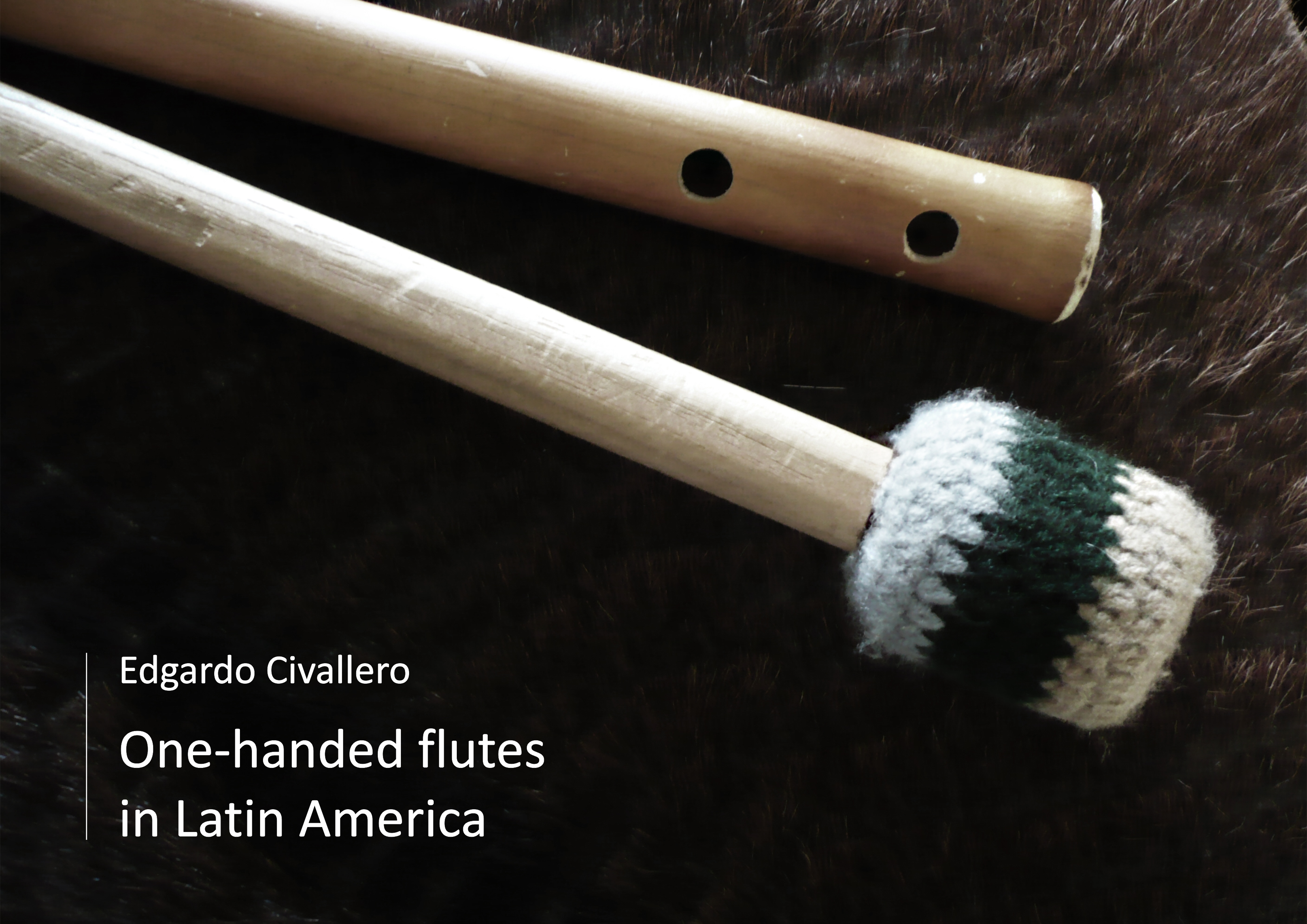
One-handed flutes in Latin America. Part I
Home > Digital books on music. Series 1 > One-handed flutes in Latin America. Part I
How to cite this work: Civallero, Edgardo (2025). One-handed flutes in Latin America. Part I: Argentina, Chile, and Bolivia. Archive edition. Bogota: El Zorro de Abajo Editora.
First edition, 2025. Archive edition, 2025 (El Zorro de Abajo Editora).
Download in PDF.
This book offers a comparative organological and ethnographic study of a distinctive instrumental practice found in several regions of Latin America: the simultaneous performance, by a single musician, of a flute and a drum. Usually, the aerophone is a duct flute with three finger holes, played with one hand, while the other hand strikes a membranophone suspended from the wrist, hand, or shoulder. Although this flute-and-drum pairing has well-known parallels in European traditions, particularly in the Iberian Peninsula, the study approaches its American forms cautiously, examining colonial influence alongside technical and cultural features that suggest substantial Indigenous precedents and processes of local reinvention.
The first part of the work concentrates on the southern Andean region, beginning in northern Chile, continuing through northwestern Argentina and southern Bolivia, and reaching the Aymara highlands of Bolivia and southern Peru. Rather than treating one-handed flutes as a single instrument type, the book examines a family of practices united by a performance technique but differentiated by morphology, materials, musical organization, seasonal restrictions, ritual functions, and local histories.
In northern Chile, the tradition survives around San Pedro de Atacama among Lickan Antay communities, where flute and drum accompany the Baile del Torito. Performed during the feasts of St John and of St Peter and St Paul, the dance brings together a small ceremonial cast centered on the figure of a bull represented by a cloth-covered wooden frame. The musician, known as the Niño Mayor, plays a three-holed pinkillo approximately 45 cm long while simultaneously striking a caja. The study describes the construction of both instruments and places their sound within the choreography and ritual sequence of the dance, from the procession through the community to the symbolic offering and slaughter of the bull. Local histories connecting the tradition with muleteers and trans-Andean cattle traffic reveal the dense relationship between music, movement, memory, and regional exchange.
The work then turns to the kamacheña of northwestern Argentina and southern Bolivia, one of the most unusual one-handed flutes of the continent. Made from giant reed or similar cane, the instrument has three or four finger holes and a semicircular notch flanked by two small lateral "wings." These projections are inserted into the player's mouth, stabilizing the flute and making one-handed performance possible despite the absence of a duct. The other hand strikes a caja chayera. Known by names such as flautilla de Pascua, quenilla, flautilla jujeña, quena, and kamacheña, the instrument is found particularly in Jujuy and Salta in Argentina and Tarija in Bolivia. Its music accompanies ruedas, coplas, tonadas, and puntos, and its use follows the seasonal organization characteristic of the southern Andes.
Closely related to the kamacheña are the so-called flautillas chaqueñas of the southern Chaco. Instruments of this broader morphological family are documented among Qom, Pi'laqá, Yofwaja, Nivaklé, and Wichi communities under a variety of vernacular names. Their materials, lengths, decoration, and number of finger holes vary considerably, and contemporary examples frequently depart from the older three-holed form. Unlike the ceremonial Andean kamacheña, these Chaco flutes are principally secular male instruments, demonstrating how a technical model may move between neighboring cultural regions while acquiring different meanings and performance contexts.
A different expression of the one-handed principle appears on the southern Altiplano, where Aymara musicians maintain several varieties of flute played together with large wank'ara drums. The most widespread is the waka-pinkillo, a three-holed duct flute made from suqusa or sokhosa cane. Unlike most Latin American flute-and-drum traditions, which are performed by solo musicians, waka-pinkillos are played communally in ensembles of ten to thirty performers. Large and small flutes sound parallel melodies approximately a fifth apart while each musician simultaneously strikes a drum, producing the dense and vibrating sonority characteristic of Aymara ensemble aesthetics.
These instruments accompany dances of the waka family, including the waka waka, waka tinti, waka tinki, and waka thuqhuri. Although modern urban versions are often interpreted as parodies of Spanish bullfighting, the book distinguishes these spectacles from rural traditions in which the bull is primarily connected with agriculture, ploughing, sowing, and offerings to Pachamama. The same region preserves other one-handed aerophones, including the liku, played for the wit'iti; the two-holed paya p'iya, associated with the pacochis; curved rollanos used in the revived liberia dance; and the little-documented pinkillo camata, performed together with a large bombo in the dance of the jach'a tata danzante.
Taken together, these traditions show that "one-handed flute" does not designate a single organological lineage, but a performance solution repeatedly adapted to different musical worlds. Duct flutes, notch flutes, small cajas, enormous wank'aras, solitary musicians, and large ensembles all participate in the same fundamental coordination of breath, fingers, and percussion. The study therefore uses the flute-and-drum pairing as a point of entry into wider histories of circulation, Indigenous transformation, seasonal music, agricultural ritual, dance, and regional exchange in the southern Andes. What appears at first to be a simple technical constraint becomes a remarkably diverse technology of coordinated sound.