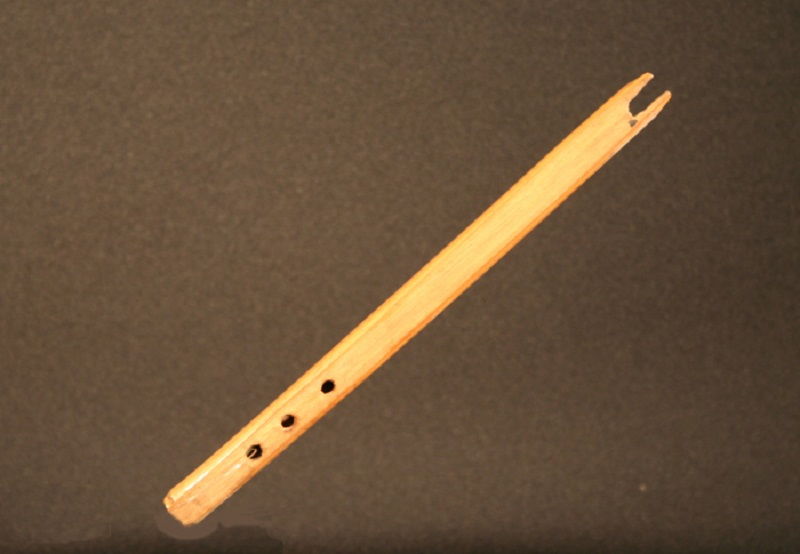
The relatives of the Andean kamacheña in Chaco
Sketch 008
Home > Blog A Musician's Log > Sketch 008
The kamacheña or camacheña (also called quena jujeña, flautilla or quenilla de Pascua) is a reed flute about 30-35 cm long, with the distal end closed and the proximal open. In the latter, a particular mouthpiece is carved, similar to that of an Andean quena (a simple notch) but equipped with two lateral wings or flaps. On the proximal it has three frontal fingering holes and a tuning one. It is performed in the department of Tarija (southern Bolivia) and in parts of the provinces of Jujuy and Salta (northwestern Argentina).
Related to the kamacheña, from which they most likely derive, the flautillas chaquenses (in Spanish, "small flutes from Chaco") are used by a good part of the indigenous peoples of the phyto-geographical region known as "Chaco austral" (northeast of Argentina, south of Paraguay and southeast of Bolivia). This set of aerophones presents a great diversity, both in the type of reed used for its construction and in the length, diameter, ornamentation (in this case, very abundant), the number of fingering holes and their arrangement. Older specimens used to have 3 holes; modern ones (perhaps influenced by the flutes of the Avá / Chiriguano people) have 6 and are played with both hands. It is an instrument for male use, devoid of any ceremonial meaning. The Argentine musicologist Pérez Bugallo points out that the eastern Qom / Toba and the Pitlaxá / Pilagá call them nashiré koktá; the western Qom, nahaide; the Yofwaja / Chorote, wosók sisé; the Nivaklé / Chulupí, vat' anjantché sisé; and the Wichi / Mataco, kanohi or, more rarely, tanowhós.
More information about this sound artifact can be found in the free-access digital book The kamacheña, accessible through the "Digital books on music. Series 1" section.