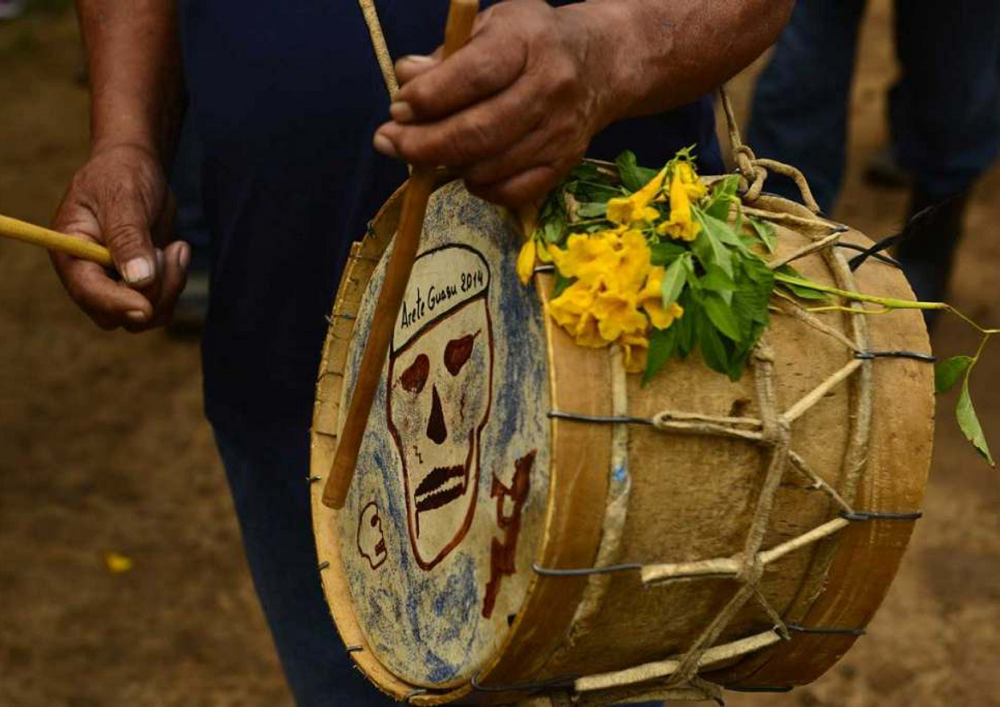
The angúa rái of the Ava people
Sketch 019
Home > Blog A Musician's Log > Sketch 019
The Ava, a Guarani-speaking people of the Bolivian and Argentine lowlands, preserved a complex musical tradition shaped by Amazonian, Arawak, Andean, and colonial influences despite centuries of warfare, displacement, and missionary intervention. Closely tied to rituals such as the aréte guásu, their musical heritage includes drums, flutes, trumpets, whistles, idiophones, and the singular turumi violin, all generally handcrafted by the performers themselves and embedded in ceremonial, social, and symbolic practices linking music, dance, memory, sexuality, warfare, and relations between the living and the dead.
Ava membranophones are a family of male-played double-headed tubular drums generically known as angúa, including the angúa guásu, angúa rái, and michi rái, whose forms and distribution varied historically between Bolivia and Argentina.
Angúa rái means "child drum"; it is also called angúa míni, "small drum." It measures 25 cm high and 25 cm in diameter, and is the intermediate size of the Ava drum set, serving as a snare drum.
Unlike the angúa guásu, the body of the angúa rái is made from a piece of carob or palm wood; the drumheads, for their part, are made of the hide of agouti, vizcacha (Lagostomus maximus), or teyuguásu lizard. The unplayed drumhead has a snare over it: a cord of bristles or twisted plant fibers called evínsa or wirapáüsa, which vibrates against the membrane, producing a sound similar to that of a European military drum.
The musician hangs the instrument from his left forearm and adjusts the handle by rotating and twisting the drum. He strikes it with two peeled sticks, multiplying the pulse marked by the angúa guásu with rolls.
It is believed that the sound of the main Ava orchestral ensemble, composed of angúa guásu, angúa rái, and flute, improves as the number of angúa rái increases. It was once used in now-forgotten funeral rites. Currently, it is only used during the celebration of the aréte guásu. Its sound — if played continuously for days — is said to have the power to make the dancers levitate collectively.
More information about these sound artifacts can be found in the free-access digital book Musical instruments of the Ava people, accessible through the "Digital books on music. Series 1" section.