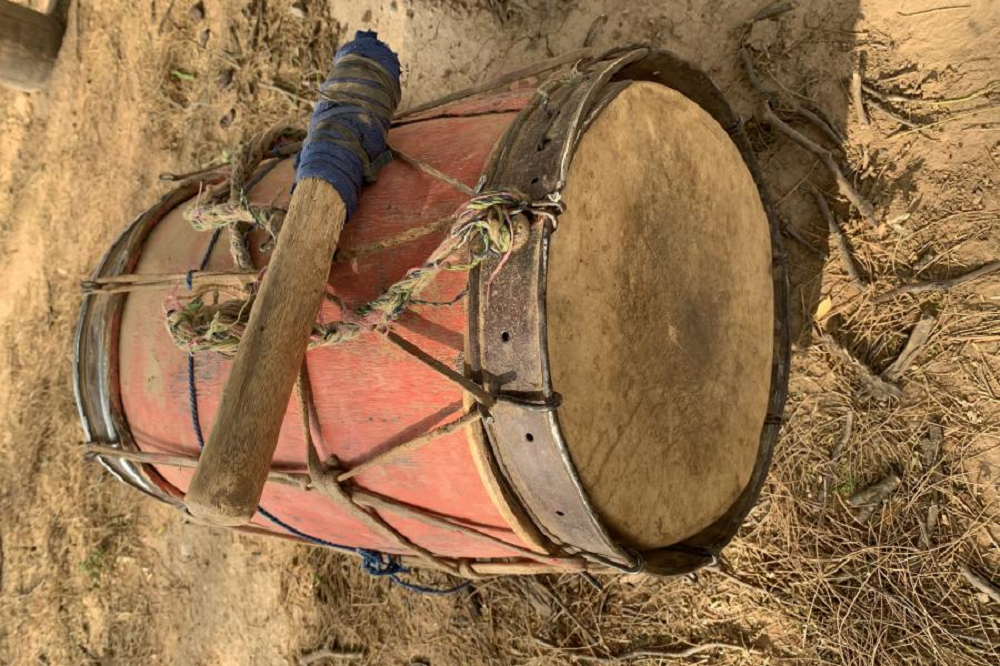
The angúa guásu of the Ava people
Sketch 018
Home > Blog A Musician's Log > Sketch 018
The Ava, a Guarani-speaking people of the Bolivian and Argentine lowlands, preserved a complex musical tradition shaped by Amazonian, Arawak, Andean, and colonial influences despite centuries of warfare, displacement, and missionary intervention. Closely tied to rituals such as the aréte guásu, their musical heritage includes drums, flutes, trumpets, whistles, idiophones, and the singular turumi violin, all generally handcrafted by the performers themselves and embedded in ceremonial, social, and symbolic practices linking music, dance, memory, sexuality, warfare, and relations between the living and the dead.
Ava membranophones are a family of male-played double-headed tubular drums generically known as angúa, including the angúa guásu, angúa rái, and michi rái, whose forms and distribution varied historically between Bolivia and Argentina.
Angúa guásu is a Guaraní name that translates as "large drum": at 50-80 cm tall and 30-50 cm in diameter, it is the largest member of the Ava drum family. It is also called angúa aretépe ("festival drum"), angúa tubícha ("chief drum"), or tambora. It is the only membranophone that the Ava considered feminine.
It is constructed by hollowing out a softwood log, usually cedar (Cedrela balansae or C. fissilis), ishpingo or Creole oak (Amburana caerensis), or zapallo caspi (Pisonia ambigua). Once hollowed out, the piece of wood is roughed out with a form until a 1 cm thick wall is obtained. A 1 cm diameter hole is then drilled in this wall with a red-hot iron, serving as a pressure relief hole (a feature borrowed from European drums). The wood can be substituted with a tin container of appropriate dimensions.
The drumheads (mboapíre) are made from the hide of the brocket deer (Mazama gouazoubira), agouti (Dasyprocta azareae), iguana (Tupinambis sp.), or green lizard (Teius teyou). The first two kinds are covered with cold ash and then scraped with the edge of a cane to remove all the hair. The non-playing drumhead can be made of cowhide and have a snare of various materials. The hide is stretched over a ring of thick vine (isípo) and sewn in a spiral with long stitches, using plant fiber or thin wire. Once the drumheads are placed on the body of the drum, two hoops of palo amarillo (Phyllostylon rhamnoides), aguay (Puoteria salicifolia), tala (Celtis tala), or peteribí (Cordia trichotoma) are added, their ends joined by wire or thong. These hoops have a series of perforations through which a thong of plant fiber, cowhide, or deer neck leather is passed in a zigzag pattern to tie them together.
To play it, the musician, standing, hangs it over his shoulder and strikes it with a mallet called a mbopúka, fitted with a head of wool and leather. It appears especially during the aréte guásu: it is said that its sound summons the living and the dead to participate in the celebration. It marks the pulse of the flute melody and signals the choreographic variations of the dance.
More information about these sound artifacts can be found in the free-access digital book Musical instruments of the Ava people, accessible through the "Digital books on music. Series 1" section.