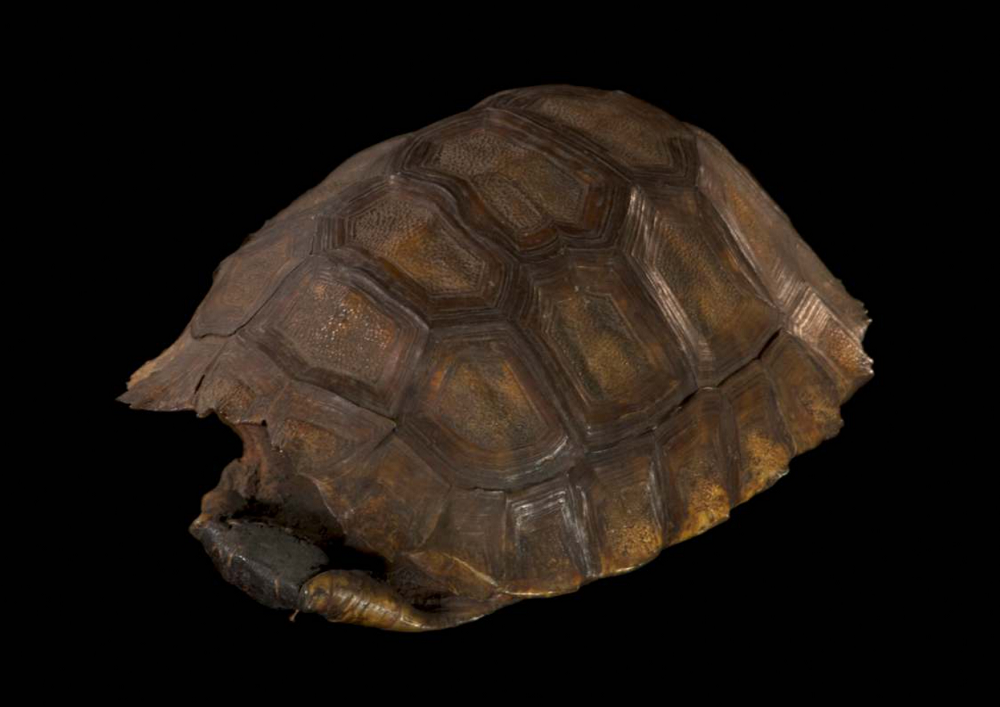
Sounding turtles of Colombia
Sketch 014
Home > Blog A Musician's Log > Sketch 014
Turtle shells have been used for a long time in the five continents as raw material for the elaboration of different types of musical instruments.
In Colombia, and according to Carlos Miñana Blasco, the Cubeo people of the Vaupés River basin (departments of Vaupés and Guaviare, and neighboring areas of the Brazilian state of Amazonas) use shells of land turtle makáku+nbó (macacûùbo or morrocoy, Geochelone carbonaria) or water turtle jiákumi (jiacûùbo or arrau turtle, Podocnemis expansa) for the interpretation of instrumental music and popular songs (yiriaino), along with panpipes and deer skull whistles.
Miñana Blasco also mentions the kjúumuhe of the Bora people (department of Amazonas), a friction idiophone whose use is no longer in force, since the large collective fishing with barbasco in which it was played together with a small flute is no longer carried out.
The Camsá or Camëntsá people (departments of Putumayo and Nariño) use a similar instrument, which they call torturés; the Ika or Arhuaco (Sierra Nevada de Santa Marta), a rubbed turtle shell called kúngüi, according to Egberto Bermúdez; and the Tikuna people of the Colombian "Amazonian Trapezium" (and nearby areas of Amazonas state, Brazil), the shell of the torí turtle — a gift from their civilizing hero, Yoi or Yoí, which, struck with a twig of ubu accompanies daily domestic songs and community festivals such as the yüü female initiation festival. The last two instruments are mentioned by Bermúdez, who also indicates their presence among the Inga people (department of Putumayo). For the Tukano or Yepa-masa (departments of Vaupés and Guaviare, and the Brazilian state of Amazonas) there are museographic references to turtle shells, apparently interpreted by friction, collected during Gerardo Reichel-Dolmatoff's expedition to Vaupés in 1967.
For their part, the Carapana or Karapana (Vaupés department) interpret the ujerica, and their neighbors, the Barasana, Paneroa or Southern Barasano, the gu coro. In the same area, the Bara, Waimaja or Northern Barasano, the Piratapuyo or Wa'ikâná and the Tatuyo peoples also use turtle shells; the former perform them together with panpipes, while the Piratapuyo call them kuú. The Cacua or Kakwâ people (Guaviare department) play turtle shells accompanying small panpipes with 2-3 pipes; the Macuna or Buhágana of the south of the Vaupés department do the same, and call the instrument gusiraga coro. In all cases, they are idiophones to which a piece of beeswax is added (usually near the lower edge) and which are interpreted by friction between the fingers or the palm of the hand.
More information about these sound artifacts can be found in the free-access digital book Turtle shells in traditional Latin American music, accessible through the "Digital books on music. Series 1" section.