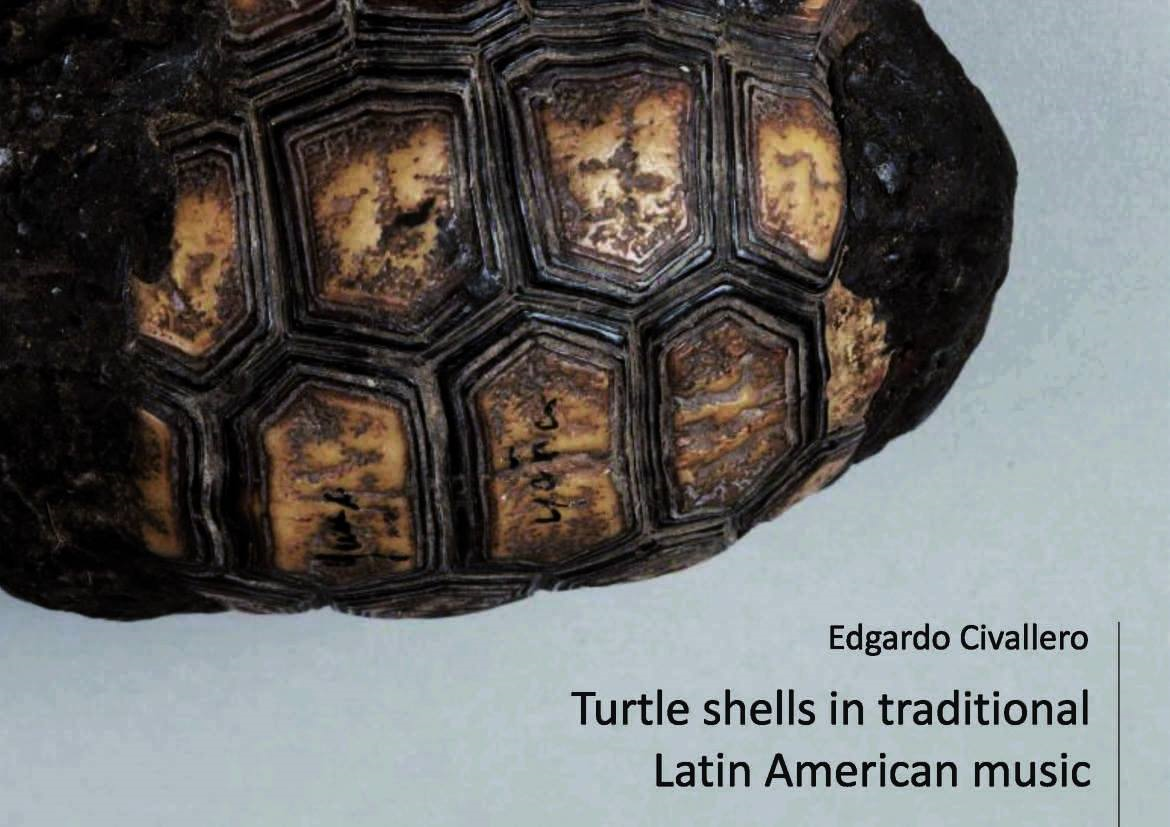
Turtle shells in traditional Latin American music
Home > Digital books on music. Series 1 > Turtle shells in traditional Latin American music
How to cite this work: Civallero, Edgardo (2025). Turtle shells in traditional Latin American music. Archive edition. Bogota: El Zorro de Abajo Editora.
First edition, 2017. Revised edition, 2021 (Wayrachaki Editora). Archive edition, 2025 (El Zorro de Abajo Editora).
Download in PDF.
This book constitutes a wide-ranging ethnomusicological and organological study on the use of chelonian shells in the sonic practices of the American continent. Through a comparative and documentary approach, the text reconstructs the functions, techniques, meanings, and regional variations of these instruments, from Mexico to Patagonia, encompassing both pre-Hispanic cultures and contemporary Indigenous and Afro-descendant communities.
From its opening, the work presents the turtle shell as a universal organological material, used across the five continents for the manufacture of idiophones, membranophones, and resonators for chordophones. In Latin America, its use dates back to time immemorial, with archaeological documentation among Mexica and Maya peoples, and transmission across centuries in multiple musical traditions. The shell, composed of carapace and plastron, may function as a complete instrument or as part of another, and is classified into three main variants: direct-struck idiophone, played with sticks; indirect-struck, used in rattles or maracas; and friction-based, when coated with resin or wax and rubbed with a finger or stick.
The text examines the theory proposed by Izikowitz (1934) regarding the expansion of these instruments from Mesoamerica into South America, and contrasts it with evidence that extends their distribution from Canada to the Chaco. Their absence in the Andes and Patagonia is offset by the analogous use of armadillo shells, employed as resonating bodies for charangos or drums.
The continental journey begins in the Paraguayan Chaco, where the Ayoreo / Ayoréiode produce the xoxo, and the Chamacoco / Yshyr make the polarosho / polasho, shamanic rattles tied to the body and decorated with feathers and cosmic motifs. The Tomárâho use maracas known as osecha or paikâra. In Bolivia, the Ayoreo craft the orohoró, shell rattles fitted with palo santo clappers, used in hunting and ceremonies, and in the Beni region the "peta resonator" is documented, a freshwater turtle shell that is struck or rubbed.
In Peru, the Culina / Madija play the teteco, a motelo shell coated with resin and rubbed to accompany panpipes, while in Colombia the variety is remarkable: the Cubeo of the Vaupés use shells of land and water turtles alongside flutes and whistles; the Bora used the kjúumuhe; the Camsá / Camëntsá use the torturés; the Ika / Arhuaco the kúngüi; and the Tikuna the shell of the torí turtle. There are also references among the Inga, the Bara / Waimaja, the Tatuyo, the Cacuá / Kakwâ, and the Tukano / Yepa-masa. The Carapana build the ujerica, the Barasana / Paneroa the gu coro, the Piratapuyo / Wa'ikâná the kuú, and the Macuna / Buhágana the gusiraga coro.
In Venezuela, the Piaroa / Wötihä perform the rere, and the Ye'kuana / Maquiritare the wayaamö ji'jo / kodedo, shells rubbed with wax in secular or ritual contexts, accompanying flutes. This combination reappears among the Wayana and Wayampi of the Guianas, the Waiwai, Hixkariyana, Mawayana, Kaxuyana, and Shereó of the Brazilian Amazon, and the Karajá of central Brazil, all with variants that associate the shell with panpipes or whistles and with ceremonial or dance contexts.
In Panama, the Emberá / Ëpërá play the chimiguí, a struck shell, while the Ngäbe / Guaymí use the ñelé / guelekuada / seracuata, a friction instrument central to the balsería / krun, where it embodies a myth of ritual origin. The Kuna, for their part, use the morrogala in initiation dances. In the Caribbean area, the Garífuna and the Miskito preserve the taguel bugudura and the kuswataya, shells struck with sticks or deer horns, and the Tawahka their equivalent cuah untak.
The Mesoamerican survey occupies an extensive section. In Guatemala, the tucutítutu accompanies Christmas Posadas. In Mexico, the "carapacho" or "concha" — in Nahuatl ayot icacahuayō / ayotapalcatl — is laden with religious and cosmogonic symbolism, linked to thunder, rain, and maize. Historical references appear in the works of Sahagún, Tezozómoc, Landa and Sánchez de Aguilar, as well as in iconographic representations in codices, murals, and chronicles. The shell (áyotl) formed an essential part of Mexica orchestras, alongside the teponaztli and rattles, and fulfilled both ceremonial and war-related functions. Among the Maya, its version kayab appears in the Bonampak murals, played with deer antlers, and is also referenced among the Mixtec and the classical P'urhépecha.
Today, the instrument survives among the Chontal of Tabasco, the Tzeltal of Chiapas, the Huave and Ikoot of Oaxaca, and the Zapotec / Binni záa, where it accompanies traditional dances with flutes and drums. Finally, among Nahua, Huastec / Téenek, Tepehua, and Totonac peoples, shells resonate during Xantolo, the festival of the dead, marking the ritual pulse that welcomes the souls.
Throughout the text, a narrative is sustained that interweaves meticulous technical description, symbolic contextualization, and historical documentation. The work goes beyond a simple catalog of instruments, proposing instead a reading of the turtle shell as a sonic archive of the continent: a natural object transformed into living memory, a link between body, land, and cosmos. Its exhaustive treatment, supported by ethnographic, archaeological, and musical sources, makes this book a fundamental reference for understanding the continuity and transformation of traditional Latin American sound technologies.