Traditional whistles of the Andes
Home > Digital books on music. Series 1 > Traditional whistles of the Andes
How to cite this work: Civallero, Edgardo (2025). Traditional whistles of the Andes. Archive edition. Bogota: El Zorro de Abajo Editora.
First edition, 2025. Archive edition, 2025 (El Zorro de Abajo Editora).
Download in PDF.
This book offers an organological, archaeological, and ethnographic study of a distinctive family of Andean aerophones: ductless, end-blown flutes with no finger holes, usually producing one or only a few sounds. Although structurally simple, these instruments belong to a long and complex musical history. Closely related to Andean panpipes in both construction and performance principles, whistles appear in archaeological traditions extending across the southern Andes and survive today in Indigenous and rural musical practices in Chile, Argentina, Bolivia, and southern Peru. The study follows this continuity from pre-Hispanic stone, ceramic, bone, and wooden instruments to present-day flutes whose dense, unstable, harmonic-rich sonorities preserve some of the most characteristic acoustic aesthetics of the region.
The first part examines the archaeological precursors of modern whistles through the history of the southern Andean antara. Pre-Hispanic antaras were single-row panpipes carved from stone, ceramic, or wood, often using so-called complex tubes: internal ducts formed from cylindrical sections of different diameters. These produced the dense, unstable, highly harmonic sound known as sonido rajado. Magnificent examples are documented among Paracas, Nasca, Moche, Tiwanaku, Diaguita, Aconcagua, and other cultures, revealing a broad history of circulation extending from the central Andes through Bolivia, northwestern Argentina, and much of Chile.
As the instrument moved southward, local makers transformed its morphology. In the San Pedro de Atacama region, four-duct stone and wooden antaras acquired rounded silhouettes and lateral handles. Farther south, Diaguita and Aconcagua craftspeople produced technically sophisticated stone instruments whose internal ducts could be tuned with wooden plugs. In Mapuche territory, related multiple-tube flutes survived as the piloilo or pitucahue, while single-tube forms were known historically as pivilcahue and later developed into the pifilka. These archaeological and historical forms demonstrate that the distinction between panpipe and whistle was often one of multiplication rather than fundamentally different acoustic principles.
The book also examines pre-Columbian end-blown flutes with one or two ducts, made according to almost the same structural principles as antaras. Archaeological examples from Bolivia and Chile include stone and ceramic instruments with complex tubes, side handles, and considerable morphological variation. Some Diaguita forms survived until relatively recent periods, while early colonial sources also describe short bone whistles known as tutucas. These instruments provide the historical bridge between ancient panpipe technologies and several living southern Andean whistle traditions.
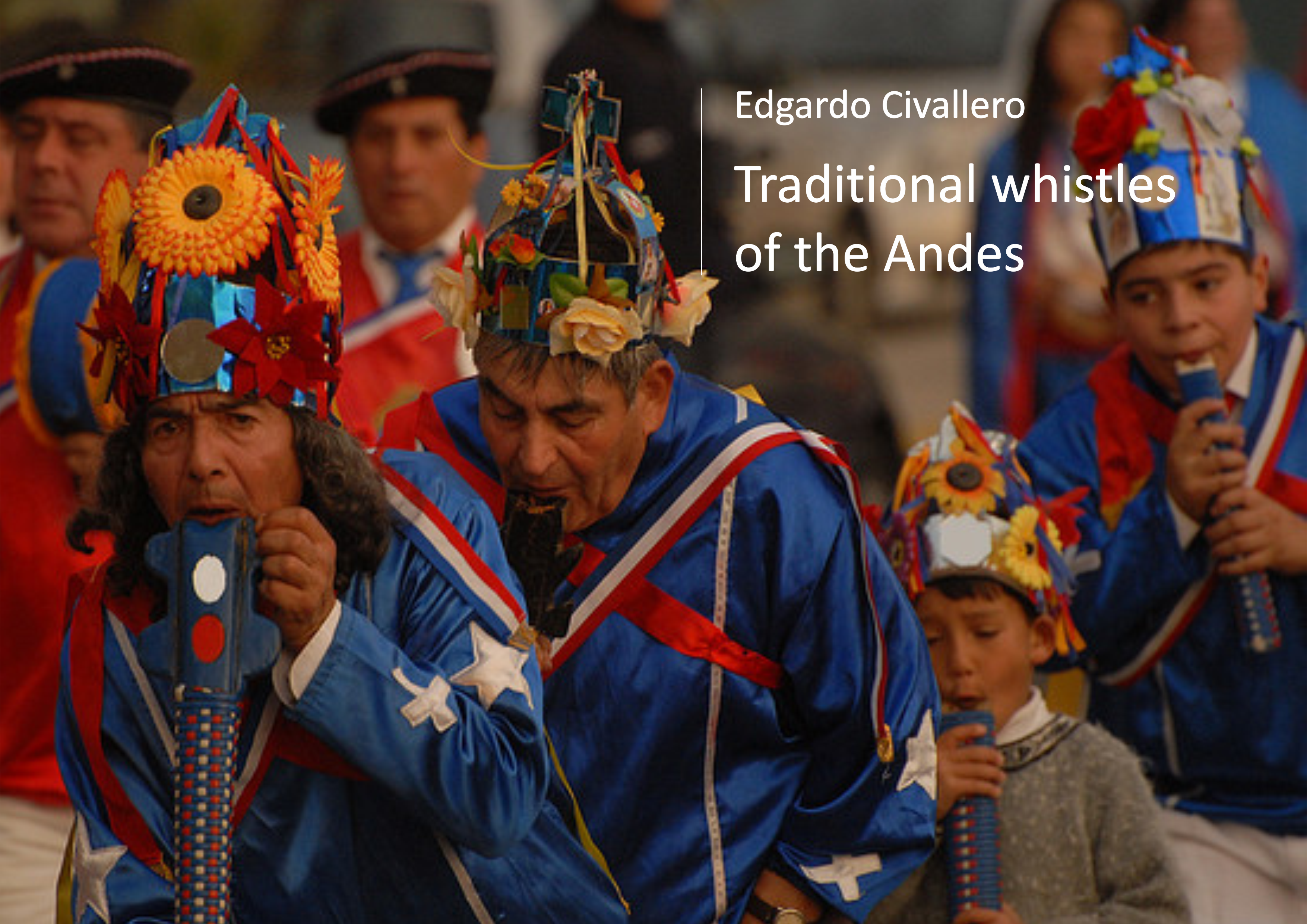
The best-known contemporary survival is found in the flutes of the Chilean bailes chinos. Played in the Norte Chico and central Chile, these wooden or cane aerophones preserve complex internal tubes and the characteristic sonido rajado of their archaeological predecessors. Some twenty musicians are typically arranged in two parallel rows according to instrument size and experience. Rather than producing melodies, each row sounds a dense mass of closely related pitches and harmonics, answering the other in prolonged alternation. The resulting music is built from timbre, beating, vibration, and acoustic saturation rather than conventional melodic development.
The study describes in detail the extraordinary sound vocabulary cultivated by chino musicians. Forceful blowing generates ganseo, gorgoreo, and the especially prized catarreo of flutes known as lloronas or catarras. Softer blowing produces the high harmonic sonido de botella, normally regarded as incorrect except when deliberately employed as bombeo. These sonic techniques are inseparable from dance. During ritual performances, musicians execute demanding mudanzas while playing short and long forms of rajado, alternating immense timbral blocks for hours under the direction of the lead drummer.
The bailes chinos remain embedded in community religious festivals dedicated to local sacred images. Inland agricultural communities perform for the Virgin in hopes of rain and good harvests, while coastal communities honor Saint Peter as protector of those who work at sea. Each baile represents its locality, and performances historically carried a competitive dimension: ensembles manipulated tempo in attempts to disturb rival groups while maintaining their own collective coordination. The music therefore operates simultaneously as devotion, bodily endurance, sonic identity, and community representation.
Farther south, the Mapuche pifilka preserves another branch of the same end-blown tradition. Carved from wood or made from sections of plant stalk, the instrument usually contains a single internal duct and produces one basic sound rich in harmonics. Pifilkas are commonly played in pairs, alternating their notes according to rhythms marked by instruments such as the kultrún. Once heard in shamanic, martial, funerary, and propitiatory ceremonies, the instrument survives principally within the ngillatún, the major Mapuche ceremony of supplication and thanksgiving.
The circum-Titicaca region preserves a very different form in the enormous tuquru flutes of the uxusiri dance. Played by groups of fifteen to thirty male dancers in the Bolivian community of Wakullani, these long reed instruments have no finger holes and produce powerful single tones containing numerous harmonics. Because their dimensions vary, the ensemble forms two broad clusters of pitches that alternate with one another, creating dense, beating chords reminiscent of the acoustic organization of the bailes chinos. Their sound accompanies a dance associated historically with potato-field guardians, harvest time, frost, hail, and the seasonal organization of Aymara agriculture.
The final major tradition examined is the jant'arki of the Bolivian highlands. Made from a rectangular block of hardwood pierced longitudinally, this fingerhole-less flute produces a principal tone and a second variant obtained by opening or closing the distal end with a finger. It survives particularly in Nor Chichas, Potosí, where it is played during Carnival and in taquipayanaku performances. Archaeological finds, early colonial iconography, and oral testimony suggest considerable antiquity. Related forms once circulated eastward into the Bolivian lowlands, where comparable instruments were documented among the Ava under names such as serere, senene, and jocüro, as well as among neighboring peoples.
Taken together, these whistles reveal a sonic history that cannot be understood through morphology alone. A flute capable of producing only one or two fundamental pitches may nevertheless generate an exceptionally complex musical world through harmonics, beating, timbral variation, alternation, collective performance, and bodily movement. From pre-Hispanic stone antaras to the vibrating masses of the bailes chinos, the paired voices of the pifilka, the immense tuquru ensembles, and the old wooden jant'arki, the Andean whistle emerges as a technology of concentrated sound: structurally minimal, acoustically dense, and deeply embedded in histories of ritual, community, landscape, and memory.