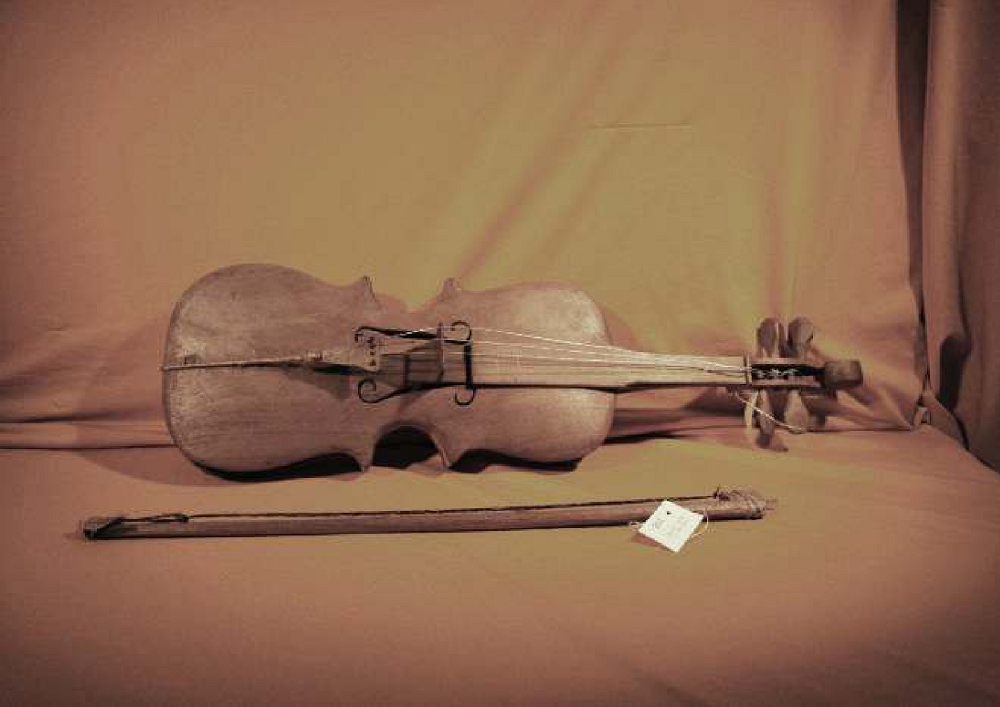
The turúmi of the Ava people
Sketch 021
Home > Blog A Musician's Log > Sketch 021
The Ava, a Guarani-speaking people of the Bolivian and Argentine lowlands, preserved a complex musical tradition shaped by Amazonian, Arawak, Andean, and colonial influences despite centuries of warfare, displacement, and missionary intervention. Closely tied to rituals such as the aréte guásu, their musical heritage includes drums, flutes, trumpets, whistles, idiophones, and the singular turumi violin, all generally handcrafted by the performers themselves and embedded in ceremonial, social, and symbolic practices linking music, dance, memory, sexuality, warfare, and relations between the living and the dead.
The turumi or miori is the only stringed instrument of the Ava people. Its size, structure, and proportions are identical to those of a European viol (despite one of its names being an indigenous corruption of the Spanish word "violín"); it is handcrafted and its appearance much more "rustic" than that of the standard instrument. Its four strings are tuned in fifths, like the violin, but a third lower.
It is constructed from a single block of cedar wood (Cedrela balansae or C. fissilis), which is carved and hollowed out. The soundboard is made separately (usually from the same wood) and a sticky substance obtained from a local climbing plant called sacha is used. The bridge is also made of cedar. The bow (mióri mbopúka) is prepared from a branch of palo amarillo (Phyllostylon rhamnoides) to which a bundle of horsehair or plant bristles (píndo rívi) is attached. The most common strings are made of thin wire or nylon thread (used as fishing line).
To play the instrument, it rests against the chest and forearm. The bridge's height, generally exaggerated, prevents pressing the string against the fingerboard; the string length is then varied by lightly resting the fingers on it (a feature probably inherited from the musical bows of the region).
In general, a slow and progressive decline in the use of this instrument has been observed, replaced by commercially produced violins. It was probably introduced to the region by the Franciscans; this missionary influence is reflected in the contexts in which the turúmi is currently played: in both Argentina and Bolivia, it appears during Easter, after the aréte guásu, playing the melodic lines of the circle dances (chánka chánka), Easter tunes, praise songs, and the wordless songs of the arerúya (hallelujah).
It is also present during the so-called "tairári season" (from May to October) until the beginning of the following "aréte season" (from October until the end of Carnival); during this period, it is often associated with the tairári, a musical genre through which singers express their feelings in just a few words — a cathartic song sung until exhaustion.
More information about these sound artifacts can be found in the free-access digital book Musical instruments of the Ava people, accessible through the "Digital books on music. Series 1" section.