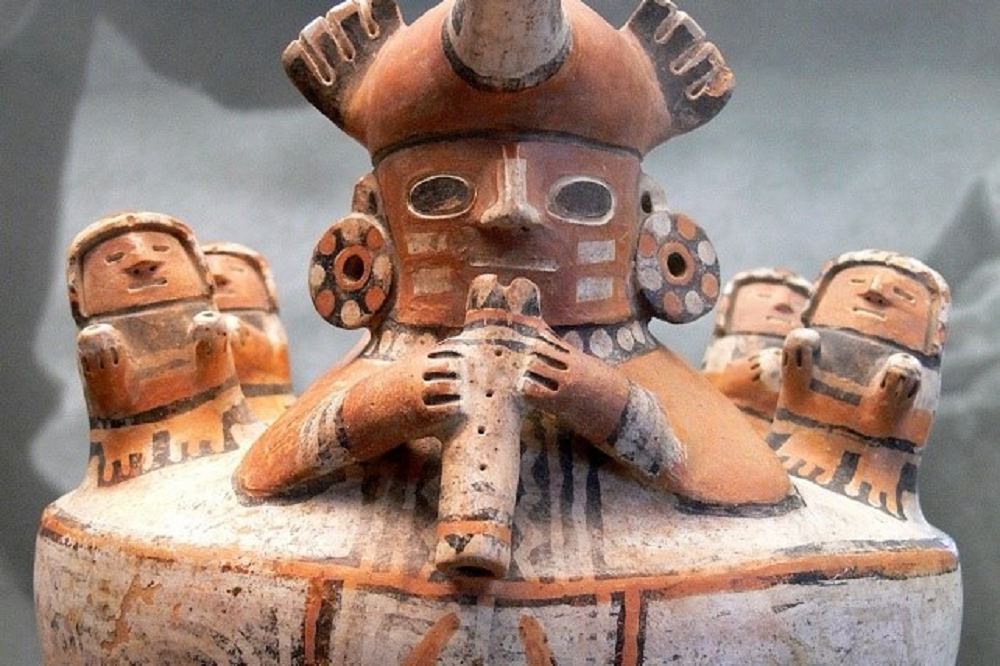
Recuay "Quena" Player
Note 021
Home > Blog A Musician's Log > Note 021
Edge-Blown Continuity in Fired Clay
In the northern highlands of Peru, the Recuay culture developed in the Ancash region during the Early Intermediate Period, roughly between 200 and 600 CE. Its ceramic tradition is especially known for sculptural vessels that model human figures, animals, buildings, and scenes of social life in three-dimensional form.
One of those vessels depicts a seated figure holding a vertical flute to the lips. The instrument is tubular. The upper end appears notched. Both hands engage the body of the flute.
The resemblance to what today would be called a quena is immediate.
Resemblance, however, is not identity.
What the Object Actually Gives Us
Recuay ceramics are sculptural rather than merely painted. They model bodies in volume. The musician is not an abstract glyph but a three-dimensional figure. In several documented examples held in Peruvian and international collections, the flute is clearly rendered as a straight tube, slightly tapered in some cases, with a visible indentation at the blowing edge.
That indentation points to an edge-blown system, not a duct flute. The absence of a fipple channel and the clear engagement of both hands make panpipes and trumpets unlikely readings. The figure is not blowing across a rimless mouth. The notch is explicit.
This tells us something precise: by the Early Intermediate Period, vertical notched flutes were known in the central Andes.
What we cannot determine from ceramic modeling are bore diameter, wall thickness, tuning system, or exact hole count. The clay does not record sound. It just records posture and form.
The Notch as Technology
In a notched flute, the player directs a narrow stream of air against a shaped edge. That edge divides the air stream and sets the air column inside the tube into vibration. The sound does not come from a reed, a whistle duct, or a vibrating membrane. It comes from the controlled instability of breath at the edge.
That small cut at the upper end of the tube is therefore a technical feature. Its form is relevant. A notch may be rounded, angular, shallow, deep, broad, or narrow. Each variation affects how the instrument responds: how quickly the tone speaks, how much breath it requires, how bright or veiled the sound becomes, and how stable the pitch feels under the player's mouth.
Modern Andean quenas vary widely in notch geometry. Some favor a sharper, more focused attack. Others produce a softer, breathier tone. These differences belong to the acoustic behavior of the instrument.
The Recuay representation does not allow us to measure the notch. We cannot know its angle, depth, internal finish, or exact acoustic efficiency. Ceramic modeling gives us the idea of the feature, not its working dimensions. But the presence of a notched blowing edge points to a deliberate way of shaping airflow.
A Form Before the Name
It would be irresponsible to claim that the modern quena descends unchanged from Recuay (or any other) prototypes. Materials shift. Scale systems shift. Finger-hole arrangements shift. Musical roles shift. Names shift.
But the structural resemblance is difficult to ignore: vertical orientation, tubular body, notched blowing edge, and two-handed playing position.
These features do not belong to the colonial period. They predate European arrival by many centuries. Whatever later transformations shaped the modern Andean quena, the basic principle of the vertical notched flute was already present in the central Andes.
The Recuay ceramic does not prove an unbroken lineage. But it does prove that the form was there.
The figure also reminds us that this was not only a technical form. The flute is shown with a body, a posture, and a social presence. The ceramic does not tell us what the performance meant. It tells us that flute-playing was visible enough to be represented.
What the Clay Refuses
We do not know the repertoire. We do not know the tuning. We do not know whether the flute accompanied ritual, courtship, healing, political ceremony, domestic music, or some context that does not fit any of those categories neatly. The ceramic figure does not give access to performance situation, social function, melodic organization, or sound quality. It fixes a gesture, not an event.
For that reason, we should resist projecting modern Andean repertoire backward into the Early Intermediate Period. The resemblance to a quena is important, but it does not authorize a direct return from the present to the past. The object allows comparison, not reconstruction.
What it offers is more modest, but still significant: morphology, posture, and representation. It shows a vertical notched flute held in playing position, represented in a ceramic tradition that gave durable form to bodies, objects, and social roles. That is enough to establish the archaeological depth of the Andean edge-blown flute tradition without claiming an unchanged lineage.
Before the violin entered the Andes, before the harp reshaped plaza acoustics, and before colonial categories renamed Indigenous sound, vertical notched flutes had already been represented in fired clay. The sound is lost, but the form is not.
Readings
- Bolaños, César. Origen de la música en los Andes: instrumentos musicales, objetos sonoros y músicos de la región andina precolonial. Lima: Fondo Editorial del Congreso del Perú, 2007.
- d’Harcourt, Raoul, and Marguerite d’Harcourt. La musique des Incas et ses survivances. Paris: Librairie Orientaliste Paul Geuthner, 1925.
- Izikowitz, Karl Gustav. Musical and Other Sound Instruments of the South American Indians: A Comparative Ethnographical Study. Göteborg: Elanders Boktryckeri Aktiebolag, 1935.
- Lau, George F. Andean Expressions: Art and Archaeology of the Recuay Culture. Iowa City: University of Iowa Press, 2011.