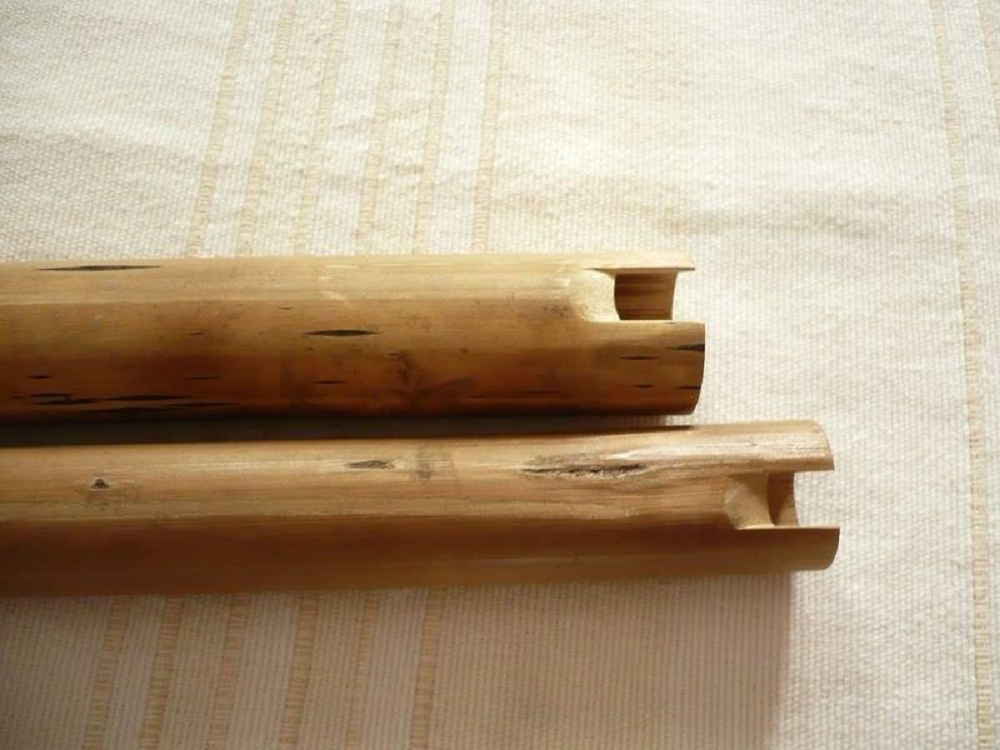
Traditional Quenas
Note 016
Home > Blog A Musician's Log > Note 016
Before the "Standard" Flute
The so-called "standard quena" — six front holes, one thumb hole, stable tuning, concert projection — is only one branch of a much older and far more diverse Andean flute ecology.
Long before conservatory players and amplified festival stages, there were multiple local forms: pusipías, quena quenas, lichiguayos, qarwanis, and others whose names vary by region and language. These are not primitive precursors of the modern instrument. They are parallel systems with different acoustic priorities.
They do not aim for orchestral clarity. They aim for force, blend, and outdoor projection.
Four Holes Are Not Incomplete
The pusipía — from Aymara pusi (four) and p'iya (hole) — typically carries four finger holes. To a conservatory ear, this appears limited. To an altiplano ensemble, it is structurally sufficient. Pitch range is secondary to collective texture.
These flutes often operate in ensemble contexts where multiple players interlock or reinforce modal centers. Precision tuning to equal temperament is irrelevant. What matters is relational pitch within a group.
The error lies in judging the flute by the repertoire it was never built to serve.
Timbre Before Smoothness
Traditional quenas are frequently made from local cane rather than from standardized industrial materials. Their bores are not always regular, and their notches may be rectangular, wide, and rough. These features shape the way the instrument asks to be played: the embouchure often requires a stronger, more direct column of air, closer to a cut than to a caress.
That demand produces a particular kind of sound. The tone can be breathy, grainy, penetrating, and rich in upper partials. But what may seem harsh in a quiet room gains purpose outdoors, where distance, altitude, wind, and collective noise quickly swallow softer timbres. In that setting, a polished tone is not automatically superior. Bright attack survives because it has work to do.
The "sweetness" associated with the modern concert quena belongs to one aesthetic history of the instrument. It should not be mistaken for the measure of all Andean flute sound.
Closer to Tarka Than to Flute
Many traditional quenas share more structural affinity with tarkas and certain pinkillos than with orchestral transverse flutes. The comparison matters less at the level of shape than at the level of musical organization. These instruments are often played in tropas: grouped sets of related flutes, commonly built in two or three sizes, whose parts combine through parallel movement, interlocking entries, and harmonic relations centered on fourths and fifths.
In that context, the flute is not conceived primarily as a solo melodic instrument. It belongs to a collective sound mass. Its value lies in volume, attack, blend, and modal anchoring rather than chromatic flexibility or individual display. A single instrument may seem limited when isolated, but the system becomes intelligible when heard as an ensemble field.
Some of these flutes are played seasonally. Some belong to specific ritual calendars. Some only make full musical sense in paired or grouped performance. The instrument is rarely autonomous in the virtuoso sense later popularized by twentieth-century soloists and staged Andean music.
The solo quena recital is a modern format. The older world is the communal aerophone field: rows of breath, size, interval, and force moving together.
Standardization as Compression
The standardization of the quena in the twentieth century did not simply refine an older instrument. It reorganized the instrument so it could function more like a Western flute: chromatic, transposable, individually playable across keys, and compatible with harmonic accompaniment governed by fixed pitch.
This change became especially important when accordions entered Andean peasant ensembles. Unlike guitars, charangos, or violins, accordions cannot be retuned in performance. Their pitch system arrives as a closed architecture. At first, quena players had to respond by carrying or using several flutes in different tunings, each one suited to a particular key or ensemble situation. The burden of adaptation fell on the flutist.
The modern standardized quena reduced that burden. By adopting the layout associated today with the concert instrument, it allowed one flute to move more easily between keys and to participate in repertoires shaped by Western harmony. This made the instrument more flexible in mixed ensembles.
The gain was practical, but the compression was real. A quena designed to move across keys under a tempered pitch regime becomes easier to teach, accompany, record, and circulate. At the same time, other quena forms become harder to hear on their own terms: local tunings, limited-hole systems, ensemble-specific pitch relations, seasonal uses, and older tropa logics begin to look like survivals around a supposedly complete modern instrument.
Standardization did not erase traditional quenas. It taught many listeners to recognize only one of them as the quena.
Before Virtuosity
The names invoked in modern quena discourse, Uña Ramos, Thevenot, and others, belong to a powerful lineage of staged and recorded Andean music. That lineage is important. It made the quena visible to audiences far beyond its local contexts and turned the instrument into one of the recognizable voices of Andean music.
But visibility has a cost when it becomes genealogy.
The danger is not that the modern quena exists. The danger is that it becomes the instrument against which all other quenas are measured. Once that happens, four holes look insufficient, rough timbre sounds defective, local tuning becomes inaccuracy, and ensemble logic disappears behind the image of the soloist.
Traditional quenas ask for a different ear. They do not need to be rescued by the concert instrument, explained as its ancestors, or corrected into its tuning system. They belong to sound worlds where breath is collective, pitch is relational, and force matters as much as sweetness.
Not every flute is meant to sing above the others. Some are made to enter the mass of sound, hold their place, and cut air together.
Readings
- Baumann, Max Peter. 1982. Music of the Indios in Bolivia. The World of Music, 24 (2), pp. 80-98.
- Bolaños, César, et al. 1978. Mapa de los instrumentos musicales de uso popular en el Perú. Lima: Instituto Nacional de Cultura.
- Cavour Aramayo, Ernesto. 1994. Instrumentos musicales de Bolivia. La Paz: Producciones Cima.
- Romero Vila, Mayolo. 2021. La evolución de la quena desde los años 80 hasta la actualidad. Monografía de pregrado, Universidad Nacional de Educación Enrique Guzmán y Valle, Lima.
Video. From YouTube user Chalena Vásquez.