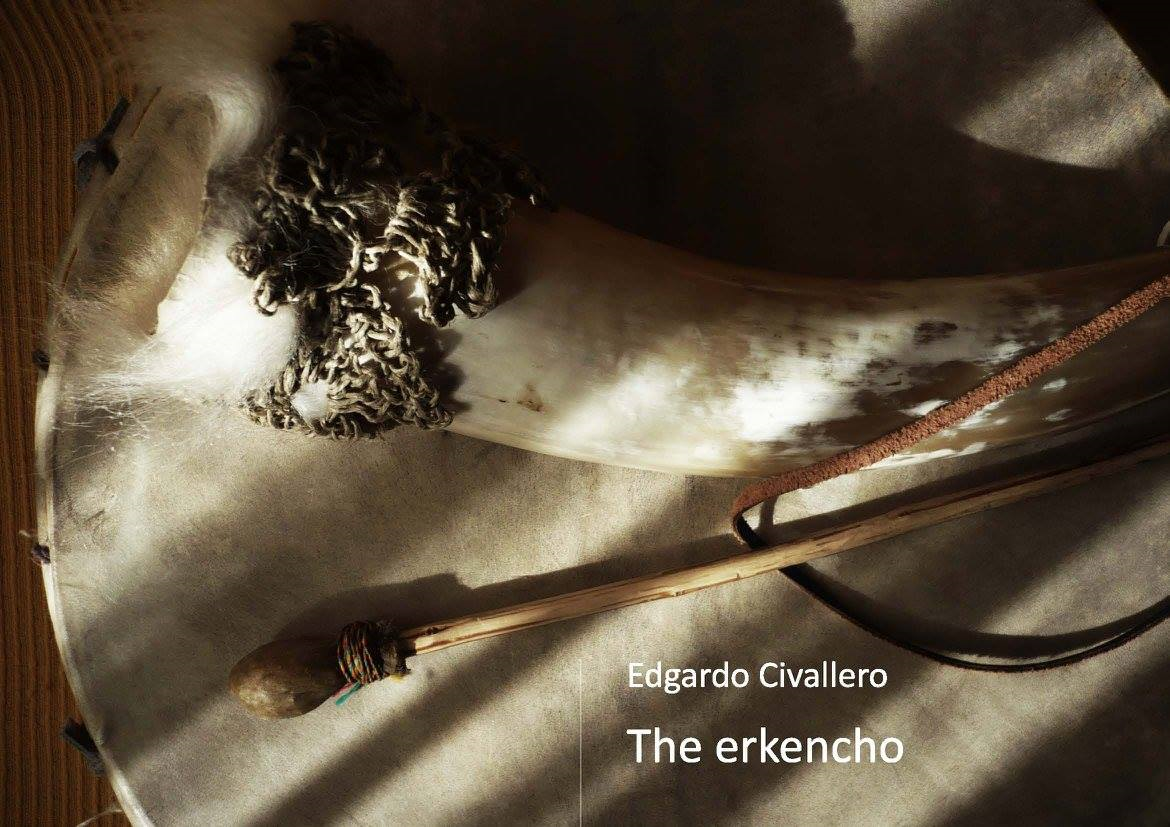
The erkencho
Home > Digital books on music. Series 1 > The erkencho
How to cite this work: Civallero, Edgardo (2025). The erkencho. Archive edition. Bogota: El Zorro de Abajo Editora.
First edition, 2017. Revised edition, 2021 (Wayrachaki Editora). Archive edition, 2025 (El Zorro de Abajo Editora).
Download in PDF.
The text constitutes a rigorous and deeply documented monographic study of one of the most singular aerophones in the southern Andean world: the erkencho or erke. Through an approach that combines organological analysis, ethnomusicological contextualization, and comparative observation, the text explores the history, morphology, social function, and symbolism of this instrument, found primarily in northwestern Argentina and southern Bolivia, within the cultural region of the former Qullasuyu.
The erkencho is described as an idioglot clarinet, the only known single-reed instrument in the Andean tradition, composed of a short cane mouthpiece or pajuela (Arundo donax or local bamboos) measuring between 8 and 15 cm, and a large amplification bell that may be made of horn, gourd, metal, or modern materials. The reed, carved directly into the cane and oriented toward the player, is kept free by the insertion of a human or animal hair, which prevents it from sticking due to moisture. The absence of finger holes does not prevent variation in pitch: the performer modulates the sound through lip pressure, breath intensity, and dental support points, generating a broad and rich expressive range.
The resulting sound, a hoarse, plaintive, and deeply human buzz, constitutes the instrument's defining mark. It is linked to the vocal aesthetics of the region, defined by the singing of coplas, an emblematic expression of northwestern Argentina and southern Bolivia. This style, identified by Carlos Vega as "tritonic music," privileges the natural voice, portamento, and falsetto or kenko (from the Quechua qinqu, "undulation"). The erkenchos reproduce and imitate these inflections, establishing an intimate relationship between voice and breath. The instrument is almost always played together with a caja, whether tinya, caja puneña, chayera, or chapaca, struck with a mallet (huajtana). Both instruments are played simultaneously by the same musician: the erkenchero holds the bell and the membranophone with one hand and strikes the caja with the other, generating a sonic texture in which the vibration of the skin and the buzzing of the reed are interwoven.
The text highlights the correspondence of the erkencho with ritual and agricultural cycles. It is classified as a "summer" or "wet-season" instrument, active between All Saints' Day and Easter, a period known as jallu pacha or paray tiempu. Andean musical taboos establish its use as masculine, although exceptions have been recorded. During Carnival celebrations, the instrument takes center stage in the erkenchadas, collective performances in which several musicians play simultaneously, without tonal concordance, creating dense heterophonic textures of great expressive power. In Bolivia it accompanies processions and religious festivals, such as that of the Virgin of Chaguaya in Tarija, while among the Jalq'a of Chuquisaca two complementary versions appear: the warmi erqe ("female erke"), high-pitched and small, and the qhari erqe ("male erke"), larger and lower in pitch. Both are combined through a hocket technique to produce shared melodies.
The following sections examine local variants. In Argentina the instrument extends across the provinces of Jujuy and Salta, with adaptations that reflect the material conditions of each area: in the puna, goat horns are used because of the lack of cattle; in eastern Jujuy, sheets of copper or bronze; and in Salta, combinations of horn and metal that reach monumental sizes. Some modern versions replace the idioglot reed with a heteroglot one, made from X-ray film or similar materials, modifying its traditional acoustic character. In Bolivia, where the name erke predominates, probably the original form, the instrument is common in the departments of Tarija, Potosí, and Chuquisaca, with decorated bovine bells and reeds opened directly at the cane node.
The text also traces the presence of the erkencho beyond the Andes, in Chaco regions and in the lowlands, where its morphology and function have been adapted to different contexts. Among the Mak'á of the central and northern Chaco, the instrument is called wakasekech; among the Ashlushlay or Nivaklé, taklúk; and among the Chorote, waka kiú. These variants, lower in register and with smaller horns, reflect the interregional diffusion of an acoustic model shared along the frontier between the highlands and the Chaco.
To date, there is no archaeological or documentary evidence that would allow a pre-Hispanic origin for the erkencho to be affirmed. The most widely accepted hypotheses link it to European rural single-reed aerophones, introduced during the colonial period and adapted to the Andean environment. Possible parallels are mentioned with the Asturian turullu and the Cantabrian berrona, which share morphology and playing technique. The adoption of the instrument by Indigenous communities would have produced a process of resemanticization, transforming a European rural artifact into a fully Andean ritual and sonic symbol.
The book is completed with bibliographic references and sound and visual documentation materials, including field recordings, heritage discs, photographs of performers, and museum collections, which reinforce its value as a pedagogical source. The text succeeds in articulating technical description, cultural context, and a poetics of sound, making the erkencho not merely a musical object, but a mirror of the identity of northwestern Argentina and southern Bolivia: a hybrid voice, born from the meeting of cane and horn, of human breath and mountain.