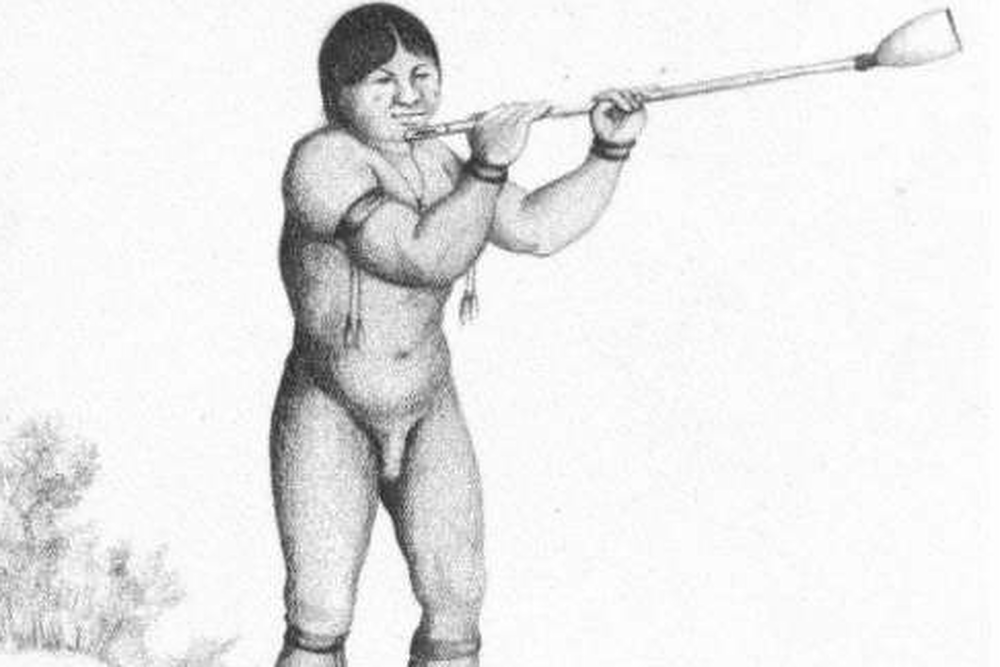
The wakaránty and the iguaéru of the Ava people
Sketch 027
Home > Blog A Musician's Log > Sketch 027
The Ava, a Guarani-speaking people of the Bolivian and Argentine lowlands, preserved a complex musical tradition shaped by Amazonian, Arawak, Andean, and colonial influences despite centuries of warfare, displacement, and missionary intervention. Closely tied to rituals such as the aréte guásu, their musical heritage includes drums, flutes, trumpets, whistles, idiophones, and the singular turumi violin, all generally handcrafted by the performers themselves and embedded in ceremonial, social, and symbolic practices linking music, dance, memory, sexuality, warfare, and relations between the living and the dead.
The wakaránty is a composite natural trumpet. Its name literally means "cow horn." In some sources, it appears as wakar'hanti or even huacananti. In Bolivia, it is often called "corneta del aréte" or "corneta del Izozog".
It is made from a piece of cane up to 2.50 m long, from which the internal nodes or partitions are removed, and a cow horn bell is added. This bell can also be made by molding the hide of an ox's tail with hot sand, a technique used in nearby Tarija (Bolivia) and Jujuy (Argentina) to make the caña tarijeña and the corneta, respectively; in that case, the instrument is called wakaráe punta ("cow tail"). In the past, according to Father Bernardino Niño (1912), the horn was also made from the hide of the tapir (Tapirus terrestris) and even from the tail of an armadillo. The priest explains that, to give the instrument a "luxurious" appearance, the lateral opening that serves as the mouthpiece was often adorned with the bark of the root of the güembé (Philodendron bipinnatifidum), an epiphytic plant.
To blow it, it is held diagonally. Depending on the source, this horn was incorporated late, as an alarm instrument, with warlike uses during battles, and to summon people to agricultural tasks during the planting of maize. Although it is used less and less, it is currently used to summon the aréte guásu and to dance the traditional Easter "rounds."
The porongos or iguaéru, for their part, are short horns made from gourds from which the seeds were removed.
More information about these sound artifacts can be found in the free-access digital book Musical instruments of the Ava people, accessible through the "Digital books on music. Series 1" section.