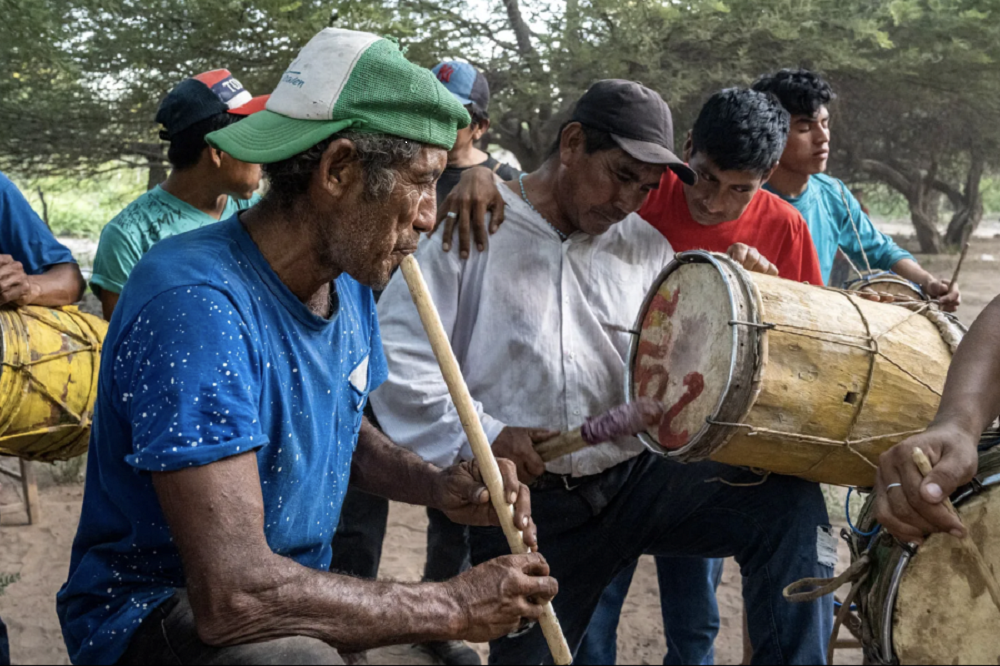
The temímby guásu of the Ava people
Sketch 024
Home > Blog A Musician's Log > Sketch 024
The Ava, a Guarani-speaking people of the Bolivian and Argentine lowlands, preserved a complex musical tradition shaped by Amazonian, Arawak, Andean, and colonial influences despite centuries of warfare, displacement, and missionary intervention. Closely tied to rituals such as the aréte guásu, their musical heritage includes drums, flutes, trumpets, whistles, idiophones, and the singular turumi violin, all generally handcrafted by the performers themselves and embedded in ceremonial, social, and symbolic practices linking music, dance, memory, sexuality, warfare, and relations between the living and the dead.
The temímby guásu has an enormous size that lives up to its name, "large flute." It is an aerophone similar to the erasos or requintos of the pinkillo mohoseño ensemble from the Bolivian highlands.
It is a vertical flute, easily exceeding one meter in length. Traditionally, it was made from takuára bamboo, although nowadays iron pipes up to 5 cm in diameter are used. It has five finger holes on the front, located in its distal half, and produces two octaves of a pentatonic scale. Its mouthpiece is that of a recorder, although, as with pinkillos mohoseños and other large Andean flutes, both the air duct and the fipple are located on the opposite side (back) of the instrument, a feature that facilitates playing.
It is of limited use. It is usually used by adult men, accompanied by one or more michi rái, to attract women.
More information about these sound artifacts can be found in the free-access digital book Musical instruments of the Ava people, accessible through the "Digital books on music. Series 1" section.