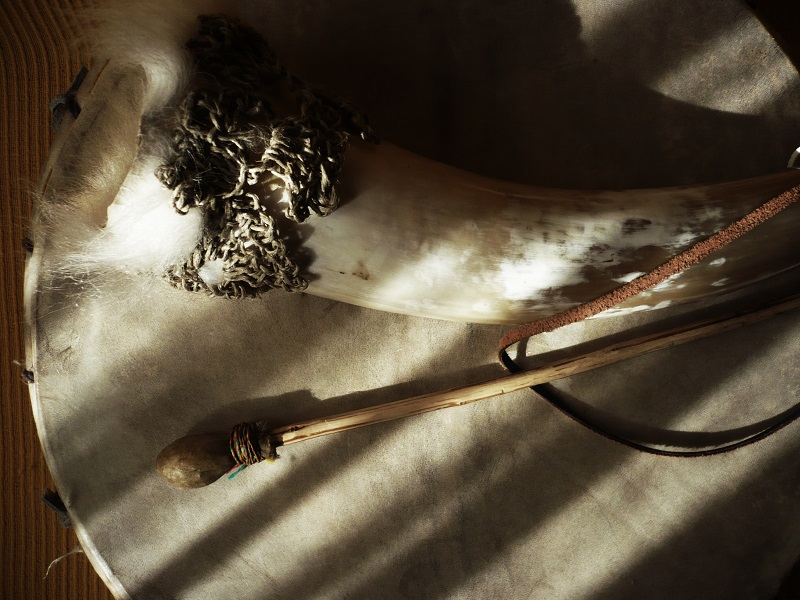
The many erquenchos
Sketch 011
Home > Blog A Musician's Log > Sketch 011
The erquencho or erque is an aerophone of traditional construction and use in northwestern Argentina and southern Bolivia. It is an idioglottal clarinet: the only single reed instrument present in traditional Andean organology. Basically, it is a reed pipe called boquilla or pajuela, between 8 and 15 cm in length and up to 1 cm in diameter, closed on one side and open on the other, and equipped with a tongue at the proximal end and a huge pavilion at the distal.
There are regional variants of the erkencho. In Argentina it is used throughout Jujuy province and in the mountainous area of Salta province, both of them located in the northwestern part of the country. In the highlands of Jujuy, the instrument's bell is usually made from goat's horn (due to shortage of cattle), and in the east of the same province, of copper or brass sheet. In Salta there are erkenchos that combine metal and cow's horn and can reach considerable sizes. In some modern versions, Argentinean builders do not cut the vibrating reed from the pipe itself; instead, they make a rectangular hole, where a small sheet of x-ray film or other similar material is inserted. Incidentally, that turns the clarinet heteroglottal.
In Bolivia, where the instrument is called erke (probably the original name) or, according to some authors, huacachupa (from Quechua wakachupa, "cow's tail"), it is mostly found in the department of Tarija, in the south of the country. It has also been located in the neighboring department of Potosí, in regions such as Calcha, and between the Jalq'a people in the department of Sucre. There, it is very common to elaborate the reed by directly splitting the node at the proximal end of the pipe, and to make the bells with huge cattle horns or gourds, in both cases densely decorated.
It is because of the influence of the Andean indigenous societies, that this highlands' instrument is also present in the neighboring lowlands ― for example among the Mak'á people from central and boreal Chaco (Argentina and Paraguay), under the name of wakasekech. Izikowitz mentions it among the Ashlushlay (Nivaklé or Chulupí) people in the same region; according to Pérez Bugallo, that people calls it taklúk, and their neighbors, the Yofwaja or Chorote people, waka kiú.
More information about this sound artifact can be found in the free-access digital book The erkencho, accessible through the "Digital books on music. Series 1" section.