The song of the erquenchos
Sketch 010
Home > Blog A Musician's Log > Sketch 010
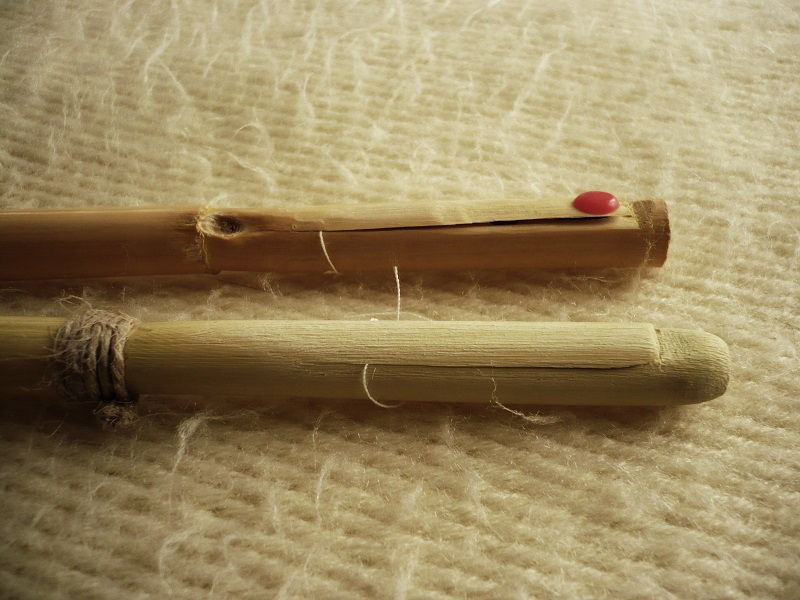
The erquencho or erque is an aerophone of traditional construction and use in northwestern Argentina and southern Bolivia. It is an idioglottal clarinet: the only single reed instrument present in traditional Andean organology. Basically, it is a reed pipe called boquilla or pajuela, between 8 and 15 cm in length and up to 1 cm in diameter, closed on one side and open on the other, and equipped with a tongue at the proximal end and a huge pavilion at the distal.
Traditional performers do not usually use clearly-determined notes: they prefer to produce a continuous sound emission (within a range limited by the physical possibilities of the instrument) that fluctuates, stopping here and there and trying to imitate, in general lines, the particular, local style of singing. Both the department of Tarija and the northwestern provinces of Argentina have a common musical culture, labeled by the Argentine musicologist C. Vega as "tritonic music" (although such a denomination is debatable). The main expression of this regional culture is the singing of couplets: short stanzas, written in local Castilian, and performed a capella by soloists of both sexes as well as by community ensembles. It is a very characteristic style, with indigenous features that can be found in other areas of the Andean world. One of the most used vocal techniques is kenko (from Quechua qinqu, "undulation"): a beautiful combination of portamento and falsetto.
Erquenchos try (and succeed) to imitate the melodies produced by the singers. Including their kenkos.
[Video. From YouTube user Fernando Tejerina]
More information about this sound artifact can be found in the free-access digital book The erkencho, accessible through the "Digital books on music. Series 1" section.