Chimú Textiles
Note 025
Home > Blog A Musician's Log > Note 025
Dress at the Edge of Sound
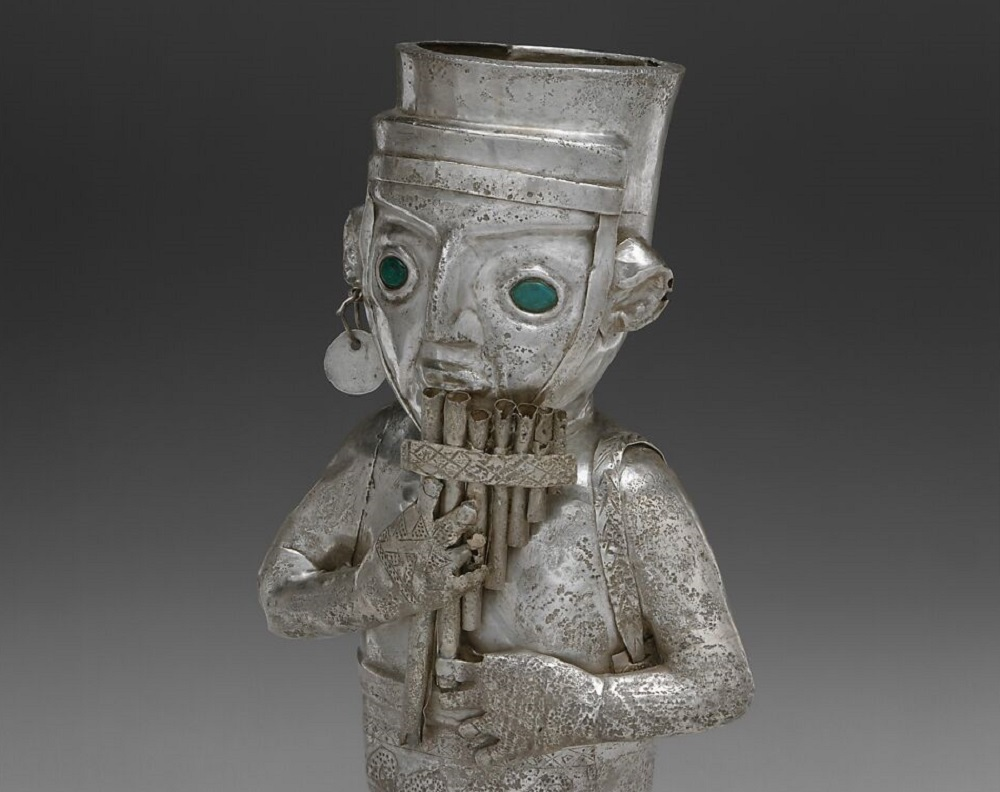
A Chimú silver vessel from the north coast of Peru, dated between approximately 1350 and 1470, depicts a man playing a panpipe. The instrument is easy to identify: a graduated row of tubes held with both hands against the mouth. Yet the figure is represented with equal attention to his clothing. He wears a patterned tunic and loincloth, a cap, earrings, and a small bag suspended from one shoulder. The geometric motifs incised into the garments correspond to designs found in surviving Chimú textiles.
The vessel does not tell us what music he played, where he performed, or what position he occupied. It does show that the musician was not imagined as an undifferentiated body holding an instrument. Dress, ornament, posture, and musical action form a single representation. The panpipe identifies an activity, while the clothing contributes to the social identity of the person performing it.
Sound appears through a body that has already been made visible and legible.
Textiles and Social Position
Textiles held considerable political, economic, and ceremonial importance in Chimú society. Cotton and camelid fibers were worked through tapestry weaving, brocading, embroidery, openwork, appliqué, and featherwork. Some garments incorporated gold or silver ornaments sewn directly onto the cloth. Differences in material, labor, design, and technical complexity helped distinguish social position and ceremonial role.
Clothing should therefore not be treated as a neutral covering surrounding the supposedly more important act of performance. A musician dressed in a patterned tunic, elaborate headgear, or metal-covered garment entered public space carrying several forms of information at once. The instrument indicated what the person was doing. The clothing helped establish who that person could be within the ceremony and how the body should be perceived by others.
This does not mean that every representation of a richly dressed musician portrays a ruler or priest. Chimú iconography does not provide such simple correspondences. It does mean that dress participated in the construction of the performer as a social figure. The sounding body was also a clothed body, and the two cannot be separated without losing part of the scene.
Silver in Motion
Among the most striking evidence for Chimú garments covered with silver plaques are detached metal elements and visual representations. The plaques were pierced and sewn onto a textile support, producing a surface that changed as the wearer moved. Museum descriptions emphasize their capacity to catch and reflect light during dances, ceremonies, and processions.
The effect would have depended on several conditions: the number and arrangement of the plaques, the movement of the wearer, the angle of the sun or firelight, and the distance from which the body was observed. Silver transformed clothing into a moving field of brightness. A person walking, turning, or dancing in such a garment did not simply carry ornament. Movement repeatedly activated the surface.
Whether the metal produced an audible sound cannot be established securely. Plaques may have brushed against the cloth or against one another, but surviving objects do not allow us to reconstruct the volume or significance of that contact. There is no need to claim that the garments functioned as instruments. Their documented visual effect is already important.
In a ceremonial setting, music and reflected light could operate together without becoming the same thing. The instrument projected sound through the air. The garment extended the visibility of the performer through movement. Both contributed to the public force of the body.
The Musician Beyond the Instrument
Organological study often isolates the object that produces sound. A panpipe can be measured, classified, reconstructed, and compared with other aerophones. Its tubes, materials, tuning possibilities, and playing position become the central evidence. The clothing of the player is then treated as contextual decoration.
The Chimú vessel resists that reduction. The panpipe occupies only one part of a carefully constructed figure. The cap, earrings, bag, tunic, and loincloth are not incidental additions surrounding a generic musician. They place musical action within a material and social setting.
This matters because instruments do not sound by themselves. They are activated by bodies whose appearance, position, and authority shape how performance is received. The same panpipe played by a ritual specialist, a court musician, a laborer, or a participant in a public procession would not necessarily carry the same meaning, even if its acoustic mechanism remained unchanged.
The surviving image cannot identify the musician with certainty. What it preserves is the inseparability of performance and presentation. Breath entered the pipes through a person whose body had already been organized by textile and ornament.
What Remains Unknown
The vessel preserves no melody, tuning, or repertory. The silver panpiper cannot tell us what scale the instrument used, whether the performance was solo or collective, or whether it belonged to ritual, political display, funerary practice, labor, or entertainment. The image fixes a posture but not an acoustic event.
The garments present similar limits. We know that some Chimú clothing used costly fibers, feathers, and metal ornaments, and that such materials could communicate rank and ceremonial importance. We do not know how every garment was worn, how it affected movement, or what specific meaning each design carried. Nor can one elite silver shirt stand for the entire textile world of the Chimú.
What survives is sufficient for a narrower argument. Musical performance was represented through socially marked bodies. Textiles and ornaments participated in that marking. In ceremonial movement, silver could turn the wearer into a shifting surface of reflected light.
The textile did not produce the panpipe's sound. It shaped the body from which that sound entered public space.
Readings
- Rowe, Ann Pollard (1984). Costumes and Featherwork of the Lords of Chimor: Textiles from Peru's North Coast. Washington, DC: The Textile Museum.
- Stone-Miller, Rebecca (1995). Art of the Andes: From Chavín to Inca. London: Thames & Hudson.