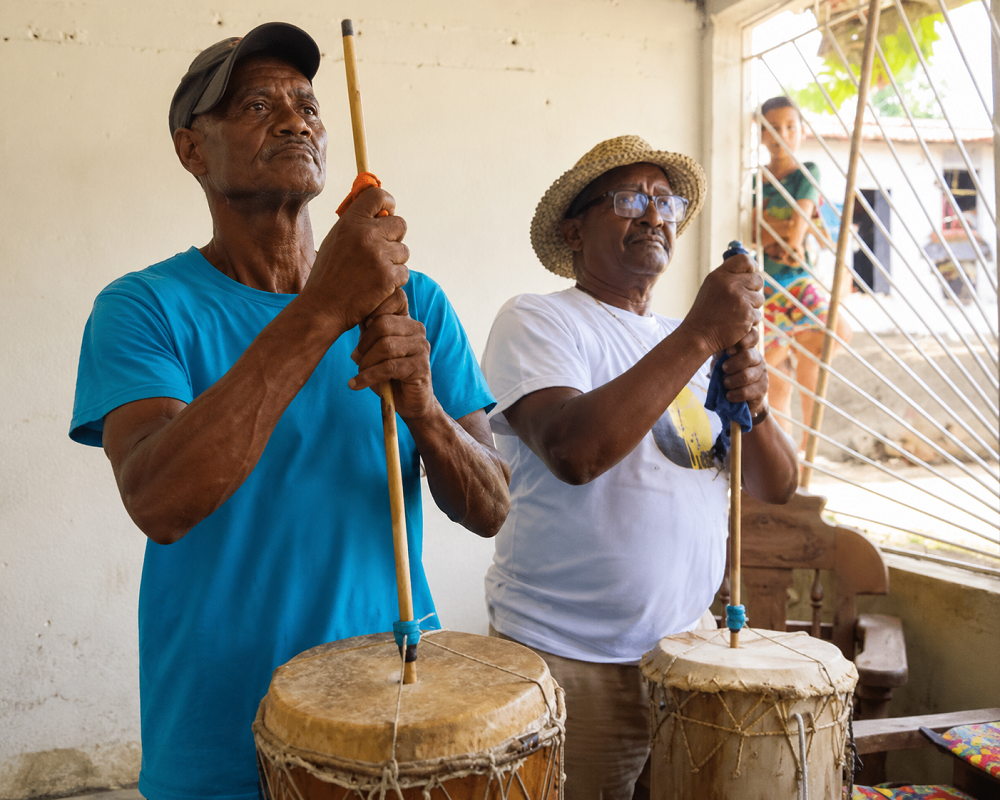
Furro or Furruco
Note 020
Home > Blog A Musician's Log > Note 020
The Friction Bass of the Gaita Zuliana
Gaita zuliana is a Venezuelan song tradition associated above all with Zulia State, especially Maracaibo and the Lake Maracaibo region. Although it now circulates throughout the year, it remains strongly linked to the Christmas season and to the festivities around the Virgen de Chiquinquirá.
One of its central forms is gaita de furro, also called gaita marabina. Its ensemble brings together voices, cuatro, tambora, charrasca, maracas, and furro.
The furro, also called furruco, is the friction bass of that ensemble. It is structurally simple: a wooden cylindrical or slightly conical body, a leather membrane stretched over one opening, and a central rod or cane activated by the performer's moistened hand.
The sound is not struck. It is pulled out.
How It Sounds
Organologically, the furro is a friction membranophone. The hand grips and releases the rod in rapid alternation, sending vibration into the membrane. The result is low, rough, unstable, and continuous.
That classification identifies the mechanism, but not the musical effect. A struck drum produces impact: attack, resonance, decay. The furro produces pressure. Its sound does not clarify pitch with precision or outline harmony as a melodic bass line would. It swells under the voices and percussion as a rough lower presence.
For that reason, calling it "bass" is useful only if bass is understood as weight rather than line.
Inside Gaita de Furro
In gaita de furro, each instrument occupies a distinct layer. The cuatro supplies harmonic and rhythmic support. Tambora, charrasca, and maracas define the rhythmic surface. Voices carry verse and refrain.
The furro occupies the lower layer. It does not compete with the voices or duplicate the percussion. It thickens the ensemble from below.
Without it, the texture changes. The rhythm may continue, the harmony may continue, the voices may continue, but the ground has shifted.
Seasonal Sound
The furro is also tied to time. Traditional accounts link gaita de furro to a cycle that begins around the festivities of the Virgen de Chiquinquirá in November and extends toward Candelaria in February.
Within that cycle, the instrument is not only heard as timbre. It becomes a marker of return. Its sound reappears with gatherings, streets, domestic celebrations, public singing, radio, and recorded gaita.
The instrument carries time as well as sound.
European Lineage
The furro is historically related to the Iberian zambomba. The connection is not only structural but explicitly recognized in Venezuelan descriptions of the instrument. Both belong to the family of friction drums, and both depend on vibration produced by rubbing rather than striking.
But the relation should not be mistaken for simple preservation.
In Zulia, the inherited principle is placed inside another ensemble logic. It becomes larger, lower, and more central to the musical texture. The zambomba connection explains where the mechanism comes from. It does not explain what the furro becomes.
What Remains
The furro matters because it gives gaita de furro a form of presence that no other instrument in the ensemble quite supplies.
It is not melody, not text, not surface rhythm. It is the vibrating underside of the song: rough, unstable, bodily, and seasonal.
The instrument remembers the zambomba in its mechanism. It belongs to Zulia in its function.
A hand pulls. The membrane answers. The song gains weight.
Readings
- Aretz, Isabel (1967). Instrumentos musicales de Venezuela. Cumaná: Universidad de Oriente.
- González R., Edepson E. (2013). Estudio sistematizado de los recursos armónicos aplicados por Humberto Bracho en el acompañamiento de la gaita de furro. Trabajo Especial de Grado, Universidad Nacional Experimental de las Artes.
- Matos Romero, Manuel (1968). La gaita zuliana.
- Ochoa, Édixon, and Elvin Yamarthee (2023). La Grey zuliana: revisión sociohistórico-musical de una icónica gaita de furro o maracaibera. Maracaibo: Fundación Ediciones Clío / Academia de Historia del Estado Zulia / Centro de Estudios Históricos de la Universidad del Zulia / Centro de Escritores Zulianos.
- Ramón y Rivera, Luis Felipe (1967). Música indígena, folklórica y popular de Venezuela. Buenos Aires: Ricordi Americana.
- Rodríguez Balestrini, Humberto (2007). Hablemos de gaitas y gaiteros. Maracaibo: Universidad del Zulia, Vicerrectorado Académico, SERBILUZ-CIDHIZ.
Video. From YouTube user Meyver Rivera.