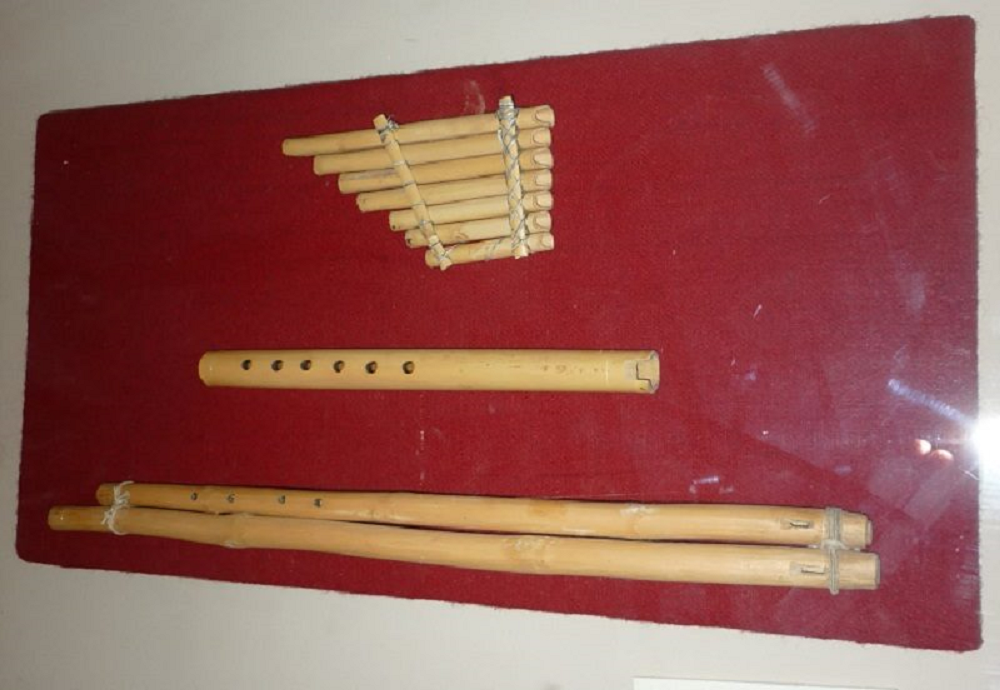
Gaita of Cajamarca
Note 018
Home > Blog A Musician's Log > Note 018
Asymmetry in a Double Flute
The Cajamarca / Hualgayoc gaita is a documented form of Peruvian double flute. It is made of babillo wood and consists of two glued tubes of unequal length. The longer tube has no finger holes. The shorter one has four front fingering holes and one rear thumb hole.
That asymmetry is the point.
This is not simply a duplicated flute. The two tubes do not do the same work. One permits variation. The other establishes a fixed sound. The instrument is built around the relation between those two functions.
Not a Bagpipe
The name "gaita" can mislead. In this case, it does not refer to a bagpipe — the meaning of the word in standard Spanish.
There is no bag, no reservoir, and no stored air pressure. Both pipes depend directly on the performer's breath. If the longer tube produces a fixed sound, that sound is not maintained by a bagpipe mechanism. It is sustained by the same act of blowing that activates the fingered tube.
The instrument therefore belongs to the logic of double flutes, not to that of bagpipes.
Two Unequal Tubes
Since the longer tube has no finger holes, it cannot articulate a melody in the same way as the shorter tube. Its role is fixed.
The shorter tube provides the variable line. But that line is not heard alone — it is heard beside the sound of the unperforated tube.
The musical interest of the gaita lies in this unequal pairing. The instrument joins movement and continuity inside one object.
Fixed Sound, Fingered Sound
The unperforated tube should not be treated as a poor or incomplete flute. Its lack of holes gives it its function.
It creates a constant reference against which the fingered tube moves. The result is not harmony in the Western chordal sense. It is a more basic relation: a moving sound placed beside a fixed one.
That relation changes the meaning of every note produced by the fingered tube. The melody is never entirely separate. It is always heard in relation to the other column of air.
One Breath
Both tubes are activated by one performer.
The relation between fixed sound and fingered sound is not produced by two musicians, or by separate instruments later combined. It is produced through one breath, divided inside one object.
The player does not simply play a melody, but activates a coupled system. The breath binds two unequal tubes into one musical event.
Why It Matters
The Cajamarca gaita is interesting precisely because the available description is small but structurally dense.
There is not enough published evidence of repertoire, use, tuning, performance occasions, or symbolic meanings. But the morphology is already meaningful. Two joined pipes, one fingered and one fixed, are enough to show a clear musical logic.
The instrument makes relation material.
It is a double flute built not on symmetry, but on asymmetry: one tube moves, one tube holds, and both depend on the same breath.
Readings
- Bolaños, César; Roel Pineda, Josafat; García, Fernando; and Salazar, Alida (1978). Mapa de los instrumentos musicales de uso popular en el Perú: clasificación y ubicación geográfica. Lima: Instituto Nacional de Cultura, Oficina de Música y Danza.
- Núñez, Moisés (1974). Instrumentos musicales de "Los gorriones de Bambamarca", de la provincia de Hualgayoc, dpto. de Cajamarca: quena doble, clarinete, gaita, antara, quena, bombo, tarola, maichil y triángulo. Interview. Typed text. Lima: Instituto Nacional de Cultura, Oficina de Música y Danza.