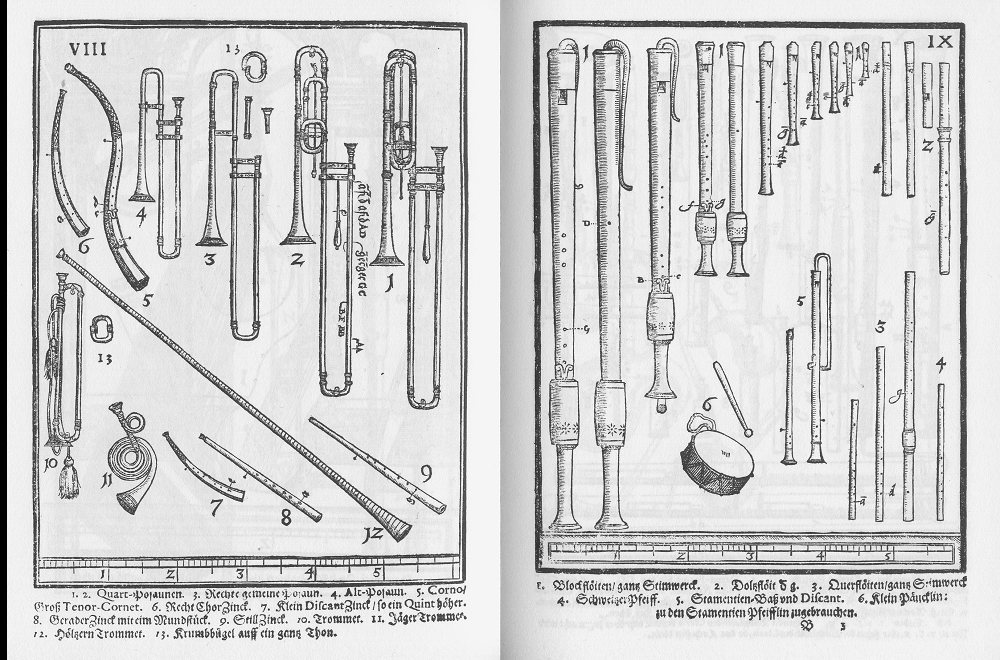
Syntagma musicum, volume 2
Note 017
Home > Blog A Musician's Log > Note 017
When Images Became Organology
Between 1614/15 and 1620, the German composer and Kapellmeister Michael Praetorius published the multi-volume Syntagma musicum, one of the most detailed musical compendia of the early seventeenth century. The second volume, De organographia (1619), is the organological core of the project. It describes instruments used in German lands and beyond, discusses construction, tuning, ensemble practice, and performance context, and does so in German rather than Latin, addressing practitioners as much as scholars.
Yet the most consequential component of this volume is not textual.
In 1620, Praetorius issued the Theatrum Instrumentorum, a separate supplement to De organographia: a collection of woodcut plates depicting instruments in careful proportional detail. These images did more than illustrate the text. They changed the way instruments could be known.
The Instrument as Visible Form
In performance, an instrument exists as action: breath pressure, bow friction, plucking force, spatial projection, social function. In the Theatrum plates, the instrument becomes a discrete object isolated from player and context. It is rendered as outline, dimension, and component structure.
Detached from gesture, the instrument appears stable. Placed alongside others on the same woodcut surface, it becomes comparable. Comparability produces order.
The plates present shawms, viols, cornetts, sackbuts, recorders, lutes, and keyboards arranged systematically. The eye moves laterally across families. Similarities and differences become legible through silhouette and scale. Length, bore, curvature, string count, and bell shape are made visually measurable.
The instrument is no longer primarily heard. It is seen.
Theater as Epistemology
The title Theatrum Instrumentorum is not cosmetic. Early modern Europe produced numerous "theaters" of knowledge: theatrical atlases, anatomical theaters, cabinets of curiosity staged for viewing. Knowledge was organized spatially before it was quantified scientifically.
Praetorius participates in this epistemic culture. Instruments are displayed, not performed. The page becomes a stage. The reader becomes spectator.
Once instruments are staged as objects, questions change. Instead of asking how they interact acoustically in ensemble, the viewer asks how they are shaped, how long they are, how they differ structurally.
Form begins to precede sound as primary data. That visual discipline becomes foundational for later organology.
Before Modern Classification
Praetorius does not offer a modern taxonomic system in the sense later codified by Hornbostel and Sachs (1914). His groupings rely on practical families and usage contexts rather than a strict acoustical principle. Yet the impulse toward classification is unmistakable.
Instruments are grouped by type. Types are treated as stable. Stability appears as inherent property.
The woodcut plate encourages the belief that instruments can be known through morphology. That belief becomes one of the genealogical roots of modern museum organology.
By the nineteenth century, instruments would be collected, catalogued, and exhibited under precisely this logic: isolated, aligned, measured, and labeled. Praetorius anticipates that gaze.
Reconstruction and Fossilization
The extraordinary precision of the Theatrum plates later made them indispensable to early music revivalists and instrument makers. Builders in the twentieth century relied on these printed plates to reconstruct cornetts, crumhorns, shawms, and viols.
The plates are therefore both archive and blueprint.
Yet the woodcut image captures a moment in instrument evolution. It freezes design into a single canonical image. Variability, local deviation, and ephemeral modification vanish. What survives is the model form. Visual authority risks fossilization.
Visual Order and Sonic Absence
The woodcuts are silent. They do not capture tuning instability, regional bore variation, reed fragility, performance posture, or ensemble balance. They cannot record microtonal practice or dynamic behavior. They preserve contour, not sound pressure.
This is not a failure of Praetorius. It is a structural limitation of visual knowledge.
But the consequence is lasting. Organology in Europe develops first as optics, later as acoustics. The instrument is defined by what can be drawn before it is analyzed by what can be heard.
Classification begins with sight.
Genealogy of the Museum Vitrine
Long before the modern museum vitrined instruments under glass, the woodcut plate created a conceptual display case. The instrument was extracted from context and aligned against a neutral ground.
The museum inherits this logic. Neutral background. Side view. Clear silhouette. Measured proportion.
Four centuries later, the method persists. The Syntagma musicum does not merely document instruments. It stages them. It teaches the reader how to look at them.
That lesson endures.
Readings
- Baines, Anthony (1992). The Oxford Companion to Musical Instruments. Oxford: Oxford University Press.
- Kartomi, Margaret J. (1990). On Concepts and Classifications of Musical Instruments. Chicago: University of Chicago Press.
- Lee, Deborah (2020). Hornbostel-Sachs Classification of Musical Instruments. Knowledge Organization, 47 (1), pp. 72-91.
- Zeller, Matthew (2019). Reconstructing Lost Instruments: Praetorius's Syntagma musicum and the Violin Family c. 1619. De musica disserenda, 15 (1-2), pp. 137-158.