Njari Mbira
Note 041
Home > Blog A Musician's Log > Note 041
A Zimbabwean lamellophone
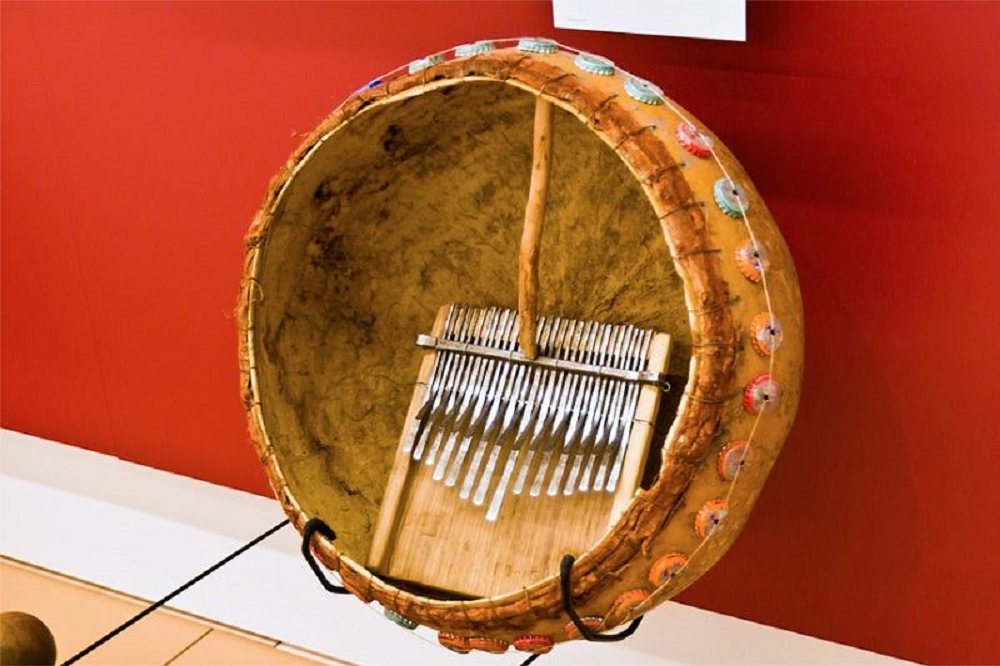
The njari is one of several types of mbira traditionally played in Zimbabwe. It consists of metal tongues mounted on a wooden soundboard, arranged in groups that allow the performer to produce melodies, bass patterns and interlocking musical figures with the thumbs and, in some configurations, the index fingers.
Its sound can be heard without any additional equipment. However, the instrument is frequently played inside a large calabash resonator known as a deze, which considerably alters its acoustic behaviour.
This arrangement is an example of a widespread principle in musical instrument construction: a vibrating element may produce a recognizable pitch while radiating relatively little sound, and a resonating structure can make that vibration more audible.
In the njari, the metal tongues, wooden board, gourd and sometimes additional rattling elements contribute different components to the resulting sound.
The njari and its construction
The njari has a history distinct from that of the better-known mbira dzavadzimu, although both belong to the Zimbabwean lamellophone traditions.
In 1932, the ethnomusicologist Hugh Tracey recorded oral accounts associating the introduction of the njari into present-day Zimbabwe with musicians arriving from the Zambezi Valley, in what is now Mozambique. According to the tradition he documented, the instrument reached the Buhera area through the Njanja people and subsequently spread into neighbouring territories. Tracey also reported that local blacksmiths manufactured instruments for circulation throughout the region.
By the middle of the twentieth century, the njari had become a familiar presence in Zimbabwean musical life. Recordings and radio broadcasts from the 1950s and 1960s document its popularity.
Its construction varies significantly between individual examples. Instruments preserved in the Tracey collection include a twenty-nine-tongue njari made by Simon Mashoko, a thirty-three-tongue example from the Mount Darwin district and a smaller nineteen-tongue instrument made by Gwenzi Gwasera.
The arrangement of the tongues is particularly important. Njari keyboards generally distribute pitches across several groups, with notes ascending outwards from the centre. Different registers can be reached through coordinated movements of the fingers, and some layouts place octave-related tongues close enough to permit their successive articulation in a single gesture. These arrangements enable the performer to develop several interacting musical patterns without requiring separate instrumental parts.
The tuning is not standardized. Local preferences and the practices of individual musicians produce variations in intervals and pitch relationships.
The resonator adds another dimension to this already complex instrument.
The deze: making a quiet instrument audible
The metal tongues of a lamellophone are relatively small vibrating bodies. When plucked, they generate sound directly, but their dimensions limit how efficiently they transfer vibrational energy into the surrounding air.
The wooden soundboard participates in this process. Vibrations reach it through the pressure assembly holding the tongues, and the larger surface contributes to the radiation of sound.
The deze modifies this arrangement. Traditionally manufactured from a dried bottle gourd (Lagenaria siceraria), the resonator is a large, open, bowl-shaped structure. The instrument is positioned inside it, often secured by a wooden wedge. The gourd can be removed, so the njari and its resonator remain physically distinct components.
Once assembled, they function as a coupled acoustic system. Vibrations from the instrument interact with the air inside the gourd and, to varying degrees, with its shell. The enclosure changes how sound is radiated into the surrounding space. The result is generally greater audibility and a fuller tone, but not necessarily a uniform increase in the intensity of every frequency.
The gourd has its own resonant characteristics. Certain frequencies may be reinforced more effectively than others, modifying the balance between the fundamental pitches and their upper partials.
This is particularly relevant to lamellophones because their tongues do not behave acoustically like ideal vibrating strings. Measurements by Lorie McNeil and Sorin Mitran, published in 2008, identified prominent inharmonic partials in the sound of an African mbira. The precise frequencies depend on the dimensions and mechanical properties of the tongues.
A resonator can influence the relative prominence of such spectral components, although the results obtained from one mbira cannot automatically be extended to every njari.
The physical characteristics of the gourd also matter. Its diameter, depth, wall thickness and rigidity influence its acoustic response. The position of the instrument within the cavity and the firmness of its contact with the resonator introduce further variables.
The selection and preparation of gourds are consequently part of the instrument maker's work. Large, suitable calabashes are valued by musicians, although their shells can be fragile. Damaged resonators are sometimes repaired, while contemporary substitutes manufactured from fibreglass offer greater durability.
The deze illustrates a form of acoustic amplification achieved through the physical arrangement of vibrating components. It does not generate additional energy, as an electronic amplifier does. Instead, it changes the manner in which the instrument's existing vibrational energy is transferred into audible sound.
The deliberate production of buzzing
The gourd performs another function when its opening is equipped with loosely attached objects, particularly bottle caps, shells or small metal elements. As the njari is played, vibrations can activate these objects, causing them to rattle against one another or against the resonator. The result is a combination of pitched tones and irregular buzzing sounds.
This effect must be distinguished from the resonating action of the gourd itself. The resonator modifies the radiation of the sound produced by the tongues; the attached rattles introduce additional sound-producing mechanisms. Their relationship is nevertheless musically important.
In their 1994 study The Fusion and Layering of Noise and Tone, Cornelia Fales and Stephen McAdams investigated how listeners perceive combinations of periodic tones and noise in African musical instruments. Depending on their acoustic characteristics, these components may be perceived as separate sounds or as aspects of a single complex timbre.
The distinction helps explain the musical significance of buzzing attachments. They do not merely accompany the notes. They can change the perceived quality of the instrument itself. The buzzing is intentional, and its intensity and character can be influenced by the selection and arrangement of the rattling elements.
In Shona musical traditions, such timbral characteristics may also possess ceremonial significance. However, these associations vary according to instrument, repertoire and performance context. The religious functions documented for the mbira dzavadzimu should not automatically be attributed to the njari.
Simon Mashoko and the musical life of the njari
One of the best-documented njari performers was Simon Mashoko, a Karanga musician and instrument maker whose work illustrates the diversity of contexts in which the instrument could be employed.
Mashoko performed traditional shave songs at social gatherings and dances, but he was also a Catholic deacon who incorporated mbira music into Christian religious activities. His musical life was documented in the 1977 film Njari: Karanga Songs in Christian Ceremonies, directed by Andrew Tracey and produced by Gei Zantzinger.
The film is particularly valuable because it places the instrument within the everyday activities of an identifiable musician rather than treating it simply as an example of an African musical instrument.
Mashoko's recordings, including his performance of Mbiriviri, also preserve examples of a repertoire in which repeating patterns, changes of register and individual melodic lines create complex instrumental textures.
The resonator contributes to the audibility and timbre of this music, but the musical organization originates in the player's technique and the arrangement of the tongues. The instrument and the resonator therefore perform complementary, rather than interchangeable, functions.
An instrument and its acoustic environment
The njari provides an interesting organological example because its principal sound-producing structure can be separated from the device that enhances its projection.
Considered alone, the wooden board and its vibrating metal tongues constitute a board lamellophone. The addition of the deze produces a larger acoustic assembly, while the rattling attachments introduce supplementary idiophonic sounds.
The njari's sound emerges from the relationship between the player's gestures, the metal tongues, their supporting board, the resonating cavity and the additional sources of buzzing.
The deze is neither a decorative accessory nor merely a container. It is an acoustic component that allows a comparatively quiet lamellophone to function more effectively in gatherings where music must be heard alongside singing, dancing and other instruments.
Its construction demonstrates how changes to an instrument's resonating environment can substantially expand its musical possibilities without altering its primary sound-producing mechanism.
Readings
- Berliner, Paul F. (1978). The Soul of Mbira: Music and Traditions of the Shona People of Zimbabwe. Berkeley: University of California Press.
- Fales, Cornelia, and Stephen McAdams. (1994). The Fusion and Layering of Noise and Tone: Implications for Timbre in African Instruments. Leonardo Music Journal, 4, 69–77.
- Grinnell College Musical Instrument Collection. (n.d.). Njari.
- McNeil, L. E., and Sorin Mitran. (2008). Vibrational Frequencies and Tuning of the African Mbira. Journal of the Acoustical Society of America, 123(2), 1169–1178.
- Sympathetic Resonances. (n.d.). Njari.
- Tinotenda. (n.d.). Mbira Resonators.
- Tracey, Andrew. (1972). The Original African Mbira? African Music, 5(2), 85–104.
- Tracey, Andrew (dir.). (1977). Njari: Karanga Songs in Christian Ceremonies. Film, produced by Gei Zantzinger. 26 min.
- Tracey, Hugh. (1969). The Mbira Class of African Instruments in Rhodesia (1932). African Music, 4(3), 78–95.
- Turino, Thomas. (2000). Nationalists, Cosmopolitans, and Popular Music in Zimbabwe. Chicago: University of Chicago Press.