The Andean Chirimía
Note 035
Home > Blog A Musician's Log > Note 035
A shawm with several names
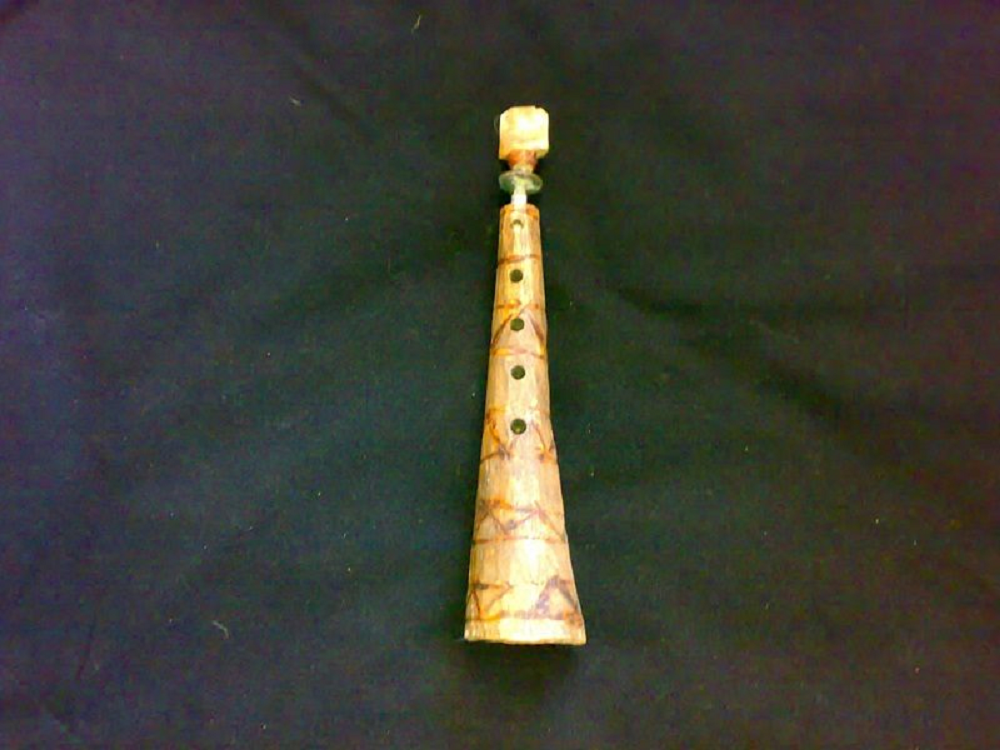
In 1942, the Argentine ethnomusicologist Isabel Aretz collected a chirisuya during a research expedition to Peru and Bolivia. The instrument, now preserved in the Instituto Nacional de Musicología Carlos Vega, consists of a slightly conical wooden tube with a flared bell, seven fingerholes, and a double reed mounted on a staple. Its documented materials include wood and bird feather.
The instrument belongs to a family of double-reed aerophones introduced into Spanish America during the colonial period. The European shawm, generally known as chirimía, acquired different names, construction methods, and musical functions as it became incorporated into regional traditions.
In Peru, related instruments have been documented under names including chirisuya, churusuya, chirimbela, dulzaina, and tiple. The distribution of these terms varies geographically and historically. In northern Peru, chirimía and dulzaina are common designations, while chirisuya appears in central and southern regions.
Related instruments also survive in Ecuador, particularly in Azuay and Cañar, where the chirimía participates in religious and festive celebrations.
These instruments share a basic construction principle, but their regional histories are not identical.
Reeds, wooden tubes, and local craftsmanship
The defining feature of the chirimía is its double reed. Two flexible blades vibrate against one another as the musician blows between them, regulating the air entering the instrument. The reed connects to a wooden body, generally with a conical bore and fingerholes for changing pitch.
The chirisuya collected by Aretz has seven fingerholes and a double reed mounted on a tudel, or staple. In Hornbostel-Sachs classification, instruments of this construction belong to category 422.112.2, single double-reed aerophones with conical bores and fingerholes.
Construction details vary considerably. Some Peruvian descriptions mention bird feathers, including condor quills, as components of the reed assembly. Others document the use of cane and different mounting arrangements.
Early twentieth-century evidence from Lambayeque provides a particularly interesting account of instrument manufacture.
The German ethnographer Heinrich Brüning recorded information about local chirimías during his investigations in northern Peru. In a field note from 1910, he described how their wooden bodies were made in highland communities, while musicians or owners could subsequently add silver rings and other ornaments.
Brüning also recalled meeting a maker in Colaya, in the highlands of Lambayeque, who worked with hualtaco wood.
Regional descriptions mention instruments approximately 25 to 50 centimetres long, generally with six or seven principal fingerholes. These dimensions, together with differences in reed construction, illustrate the diversity of local craftsmanship.
In Ecuador, Patricia Pauta Ortiz (2013) documented a chirimía used during the Fiesta del Señor de las Aguas in Girón. Approximately 28 centimetres long, the instrument has a conical wooden body and a double reed generally made from guadua, with metal incorporated into its mouthpiece assembly.
Thus, while these instruments belong to a recognizable organological family, their construction reflects different regional materials and manufacturing traditions.
From colonial institutions to local celebrations
The presence of shawms in the Andes belongs to the broader history of instruments introduced through Spanish colonial expansion.
In Iberia, chirimías had long accompanied processions, civic celebrations, religious ceremonies, and outdoor instrumental ensembles. During the colonial period, European wind instruments became part of musical activities organized around churches, educational institutions, and public festivities in Spanish America.
Robert Stevenson (1968) documents the participation of Indigenous musicians in these colonial instrumental traditions. In Ecuador, historical accounts associated with the Colegio de San Andrés in Quito describe the instruction of Indigenous and mestizo musicians in singing and instrumental performance during the sixteenth century, including the teaching of chirimía.
These records establish an early institutional presence for the instrument. Its subsequent regional development, however, can be examined more concretely through the musical practices documented in Peru and Ecuador.
The chirisuya in Peru
In July 2008, Peru's Instituto Nacional de Cultura declared the chirisuya part of the country's National Cultural Heritage through Resolution No. 997/INC, published on August 3.
The declaration recognized regional names such as churusuya, chirimbela, and tiple, and identified several traditions in which the instrument played an important role.
One was the Fiesta del Agua in the upper Santa Eulalia River basin, east of Lima, where musical performance accompanies communal activities associated with irrigation. The instrument was also documented in the festivities of the Virgen de Cocharcas in Apurímac and the Virgen de las Mercedes in Ferreñafe, Lambayeque. In northern Peru, chirimía music was associated with the dance of Los Diablitos, particularly in Mochumí and Túcume.
The declaration also recognized the specialized knowledge of the musicians who performed these instruments. Depending on the region, they could be known as tripleros, chirisuyeros, or chirimiyeros. Their participation was connected with specific ceremonial occasions and established musical repertoires, rather than simply with the availability of an instrument.
Some of these traditions also survive in early sound recordings. Between 1910 and 1925, Heinrich Brüning used a wax-cylinder phonograph to record musicians in Lambayeque and Eten. His collection includes dances, marches, and other instrumental performances from the northern Peruvian coast.
One recording, catalogued as a processional march, identifies chirimía and caja among its instruments. A clarinet also appears in the historical catalogue description, although subsequent examination has raised doubts about whether it can actually be heard. The cylinders are particularly valuable because they preserve performances from an instrumental environment documented more than a century ago. Brüning's notebooks complement the recordings with observations about musicians, instrument makers, and regional terminology.
Later fieldwork revealed changes in these practices. During investigations undertaken in Lambayeque in 1990–1991, researchers from the Instituto de Etnomusicología of the Pontificia Universidad Católica del Perú interviewed musicians associated with Los Diablitos. Among them was Victorino Acosta, identified as one of the remaining chirimía players in a locality where the instrument was increasingly being replaced by flutes.
The documentation therefore records different circumstances: instruments still played in certain celebrations, traditions undergoing replacement in particular communities, and earlier performances preserved through recordings and museum collections.
The chirimía of Girón, Ecuador
Southern Ecuador provides another example of the instrument's incorporation into regional ceremonial life.
Raúl Garzón Guzmán (1994) documented the chirimía in rural areas of Azuay and Cañar, particularly in association with religious festivities. A more detailed investigation was undertaken by Patricia Pauta Ortiz, whose fieldwork in 2008 and 2009 examined the Fiesta del Señor de las Aguas in Girón, Azuay.
The celebration extends over several weeks and combines religious ceremonies, processions, dances, communal preparations, and activities organized through a system of priostes, or festival sponsors. Different musicians fulfil different functions during these events. Pauta Ortiz describes the participation of a Maestro de la Chirimía, accompanied by a redoblante player. Violinists, wind bands, accordionists, saxophonists, and other performers also participate in the festivities.
The chirimía has a distinctive responsibility in announcing and coordinating ceremonial activities. One of its principal melodies, La Llamada, signals the beginning of the celebration and summons participants. The instrument also accompanies processions and contributes to organizing the movements of the Escaramuza, a ceremonial equestrian performance.
The position of the musician is equally important. Pauta Ortiz documents how priostes formally invite established chirimía players, recognizing their knowledge of the repertoire and the responsibilities associated with their performance.
The instrument is therefore connected with particular melodies, ceremonial moments, and relationships among musicians and festival organizers. This is a different musical history from those documented in the Peruvian irrigation ceremonies or the dances of Lambayeque, despite the instruments' shared construction principle.
One name, different instruments
The geographical variation of the word chirimía introduces another complication. In parts of Colombia, including the Cauca region, the term can refer to a flute-led musical practice or an instrumental ensemble rather than a double-reed shawm.
The name has therefore followed different paths. In some Peruvian and Ecuadorian traditions, it continues to designate an instrument structurally related to the European shawm. Elsewhere, it has acquired meanings associated with different instruments and collective musical practices.
For historical research, this distinction is essential. Encountering the word chirimía in a document does not, by itself, establish which instrument was played. The evidence must come from the actual descriptions, surviving instruments, recordings, and performance traditions associated with each locality.
Readings
- Baines, Anthony. 1967. Woodwind Instruments and Their History. 3rd ed. London: Faber & Faber.
- Garzón Guzmán, Raúl. 1994. "Acercamiento a la chirimía." Sarance 20: 103–120.
- Instituto Nacional de Cultura del Perú. 2008. Resolución Directoral Nacional N.º 997/INC: Declaran Patrimonio Cultural de la Nación al instrumento musical de viento Chirisuya. July 25. Published in El Peruano, August 3, 377504–377505.
- Instituto Nacional de Musicología Carlos Vega. n.d. "Chirisuya." Musical Instruments Collection, object 099. Collected by Isabel Aretz during the 1942 research expedition to Bolivia and Peru.
- Pauta Ortiz, Patricia. 2013. "Transculturación musical en la fiesta del Señor de las Aguas de Girón: estudio de la apropiación y cambio de rol de la chirimía y el violín." Revista del Instituto de Investigación Musicológica Carlos Vega 27: 171–195.
- Real Academia Española. 2025. "Chirisuya." Diccionario histórico de la lengua española. Version of June 25, 2025.
- Stevenson, Robert. 1968. Music in Aztec & Inca Territory. Berkeley: University of California Press.
- Yep, Virginia. 2024. Don Enrique y la música de los Moche. Lima: Instituto de Etnomusicología, Pontificia Universidad Católica del Perú.