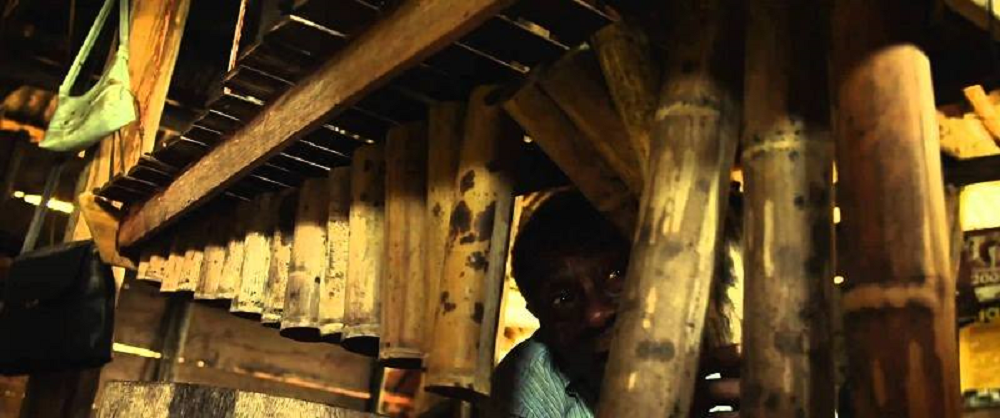
Marimba de chonta
Note 034
Home > Blog A Musician's Log > Note 034
A marimba from Buenaventura
Around 1960, the musician and instrument maker Teófilo Potes constructed a marimba in Buenaventura, on Colombia's Pacific coast. Now preserved in the Banco de la República's musical instrument collection, it consists of twenty-three wooden bars, twenty-three bamboo resonators, a supporting structure made from wood and vegetal fibres, and mallets with latex-covered heads.
The instrument measures approximately 180 centimetres in length and was designed to be played by two musicians. It could be suspended from overhead supports or placed on a separate frame.
This marimba belongs to an instrumental tradition particularly associated with Afro-descendant communities of Colombia's southern Pacific coast and Ecuador's Esmeraldas province. Its music accompanies celebrations, dances, and other communal activities, often in combination with drums, rattles, and singing.
Organologically, the marimba de chonta is a struck idiophone. The Banco de la República classifies the instrument made by Potes under Hornbostel-Sachs category 111.222.22, identifying it as a set of percussion plaques with resonators.
Its construction brings together several materials, each selected and prepared for a particular function. The wooden bars produce the principal sounds, bamboo tubes reinforce them, and the supporting structure allows the bars to vibrate. But the instrument's musical characteristics depend equally on how those materials are prepared and tuned.
Working with chonta and guadua
The sounding bars are traditionally manufactured from the hard outer wood of palms known locally as chonta. The name does not necessarily identify a single botanical species throughout the region. Ecuadorian sources document the use of Bactris gasipaes, while chonta is also applied to other palms, including Iriartea deltoidea.
Builders select material capable of producing a clear sound when struck. The bars must possess sufficient rigidity and elasticity, but their acoustic behaviour also depends on their dimensions, density, and internal structure.
Traditional construction involves cutting the palm wood into pieces, preparing and drying it, and gradually shaping the bars. These procedures vary among builders. Documentation from Esmeraldas describes the selection of mature palm material, immersion in water during preparation, and subsequent drying near a wood-burning stove. Workshops in Guapi employ their own methods.
Tuning requires adjustments to individual bars, generally through the removal of material and repeated testing. Pieces obtained from the same palm do not necessarily respond identically, so the maker must evaluate each one.
Below the bars hang resonators traditionally constructed from guadua, a large bamboo. Each tube is associated with a particular bar, and its dimensions are adjusted to reinforce components of that bar's sound.
When struck, the wooden bar vibrates in several modes. The column of air enclosed in the bamboo tube has its own resonant frequencies, determined partly by its length and internal dimensions. The builder adjusts the relationship between the two components to obtain the desired acoustic response.
The bars rest on a supporting structure, sometimes called the cama, where vegetal fibres provide a relatively flexible contact surface. Older marimbas were commonly suspended from overhead supports, while contemporary instruments may incorporate freestanding frames.
The result depends on the maker's knowledge of materials and their behaviour. Selecting suitable palm wood is only the beginning. Preparing the bars, adjusting their dimensions, matching them with resonators, and establishing the desired tuning are distinct stages of construction.
Tuning outside equal temperament
One of the most extensively investigated characteristics of the traditional marimba de chonta is its tuning.
In 2010, Carlos Miñana Blasco published a study comparing pitch measurements from nine marimbas associated with the southern Colombian Pacific and northern Ecuador. His research challenged descriptions that treated these instruments as imperfect approximations of Western diatonic or chromatic scales.
The intervals measured between successive bars differed from those of twelve-tone equal temperament. Several instruments were compatible with an approximately equi-heptatonic organization, in which the octave is divided into seven roughly comparable intervals.
Such a system differs substantially from the tuning of a piano, whose octave contains twelve equal semitones. An equi-heptatonic organization produces a different distribution of interval sizes and therefore different relationships among the notes.
Miñana did not establish that every marimba in the region followed one universal tuning system. His sample was limited, and the instruments themselves exhibited differences. The significance of his findings lay in demonstrating the existence of systematic pitch relationships that could not be adequately described through conventional Western categories.
The methods used by traditional builders are equally important. Research documented by the Universidad Nacional de Colombia describes instrument makers who established pitch relationships through listening and remembered musical patterns. A builder might reproduce intervals from a familiar vocal melody, establish several reference bars, and then use them to determine the remaining pitches.
This procedure does not necessarily require a fixed external pitch standard. The builder works from remembered relationships among sounds, making adjustments until the bars correspond to the musical organization being sought.
Consequently, two traditional marimbas may differ in absolute pitch or intervallic arrangement without either being incorrectly tuned. Their suitability must be considered in relation to the musical practices for which they were constructed.
How tuning affects performance
The relationship between tuning and musical practice was examined further by Jorge E. Useche, Rafael G. Hurtado, and Federico Demmer in a study published in 2019.
Their research considered the interaction between the marimba's tuning, timbre, and melodic organization. Rather than measuring individual pitches in isolation, they investigated how combinations of sounds relate to the musical patterns performed on the instrument.
One important aspect concerns the movement of melodic figures across the keyboard. A musician may reproduce a familiar pattern beginning on a different bar while preserving the spatial relationships among the notes. The sequence of movements remains recognizable, even though the resulting intervals may not correspond exactly to a transposition measured in equal-tempered semitones.
The study examined how these procedures interact with the instrument's tuning and the perceptual relationships among its sounds. A tuning system cannot always be understood independently of the ways musicians use it. The intervals between adjacent bars matter, but so do the combinations selected during performance, the repetition of established figures, and the relationships between simultaneous instrumental parts.
Miñana's measurements and the later investigation by Useche and his colleagues approach the problem from complementary directions: the construction of a particular pitch organization and its use in musical performance.
Two musicians at one instrument
Traditional marimbas de chonta may be played by two musicians working simultaneously on different sections of the keyboard.
The lower register is commonly associated with the bordonero, who maintains recurring patterns that provide rhythmic and musical continuity. The upper register is played by the tiplero or requintero, whose part includes melodic figures, variations, and ornaments.
These roles should not be reduced to a rigid division between accompaniment and melody. Both musicians participate in the rhythmic organization of the performance, and their parts interact through repetition, variation, and coordinated patterns.
The marimba also forms part of a larger ensemble. A common configuration includes two bombos, two cununos, and several guasás. The bombos are larger drums; the cununos are smaller drums played with the hands; and the guasás are shaken idiophones that frequently accompany singing.
These instruments participate in festive musical forms such as currulao, juga, pango, and caderona, where instrumental performance is closely associated with singing and dancing.
The marimba does not, however, accompany every musical practice of the region. Colombia's 2010 Plan Especial de Salvaguardia distinguishes between repertoires performed with marimba ensembles and other traditions in which different instrumental combinations, or unaccompanied voices, predominate.
Certain arrullos dedicated to saints and forms of bunde associated with wakes for young children are traditionally accompanied primarily by drums and rattles. Alabaos, performed during adult funerary observances, are frequently sung without instrumental accompaniment.
These distinctions are important for understanding the place of the marimba within the region's musical culture. Its central role in particular festivities does not imply its presence in every ceremony or vocal tradition.
African connections and historical questions
The marimba de chonta is strongly associated with Afro-descendant musical traditions along the Pacific coasts of Colombia and Ecuador. Its construction and performance have frequently been compared with African xylophone traditions.
These comparisons have substantial organological interest. African instruments documented by researchers such as Gerhard Kubik exhibit sophisticated systems of bar construction, resonators, tuning, and multipart performance.
Miñana also examined possible relationships between the intervallic organization of Pacific marimbas and tuning systems documented in Africa. Such comparisons, however, do not establish a single uninterrupted history of transmission.
The historical documentation is incomplete, and musical instruments have circulated and changed through interactions among different populations. Eduardo Restrepo (2026) has questioned accounts that present an exclusively African origin as an established fact, drawing attention to the changing historical interpretation of the instrument and evidence of marimba practices among Indigenous communities.
This does not negate the importance of African contributions to Afro-Pacific musical culture. It means that the precise historical development of the instrument requires more than identifying similarities between present-day instruments.
Changing instruments, changing tunings
Marimba construction continues to develop in response to different musical and educational circumstances.
In Guapi, Cauca, the Palma Chonta workshop associated with Ever Riascos has produced instruments for local musicians, educational projects, and professional performers. Its work includes preparing chonta bars, manufacturing resonators, constructing supporting frames, and tuning completed instruments.
Contemporary marimbas may incorporate independent wooden stands instead of being suspended from roof beams. These structures facilitate transportation and performance in concert settings.
Tuning practices have also diversified. Some builders reproduce traditional intervallic arrangements, while others construct marimbas compatible with Western equal temperament, particularly for performances involving pianos, guitars, and other conventionally tuned instruments. Both approaches demand technical skill. The difference concerns the musical relationships that the resulting instruments are intended to accommodate.
In 2010, UNESCO inscribed the marimba music and traditional chants of Colombia's South Pacific region on its Representative List of the Intangible Cultural Heritage of Humanity. In 2015, the designation was expanded to include Ecuador's Esmeraldas province. This recognition concerns living musical practices, including instrumental performance, singing, dancing, and the transmission of knowledge within communities.
The coexistence of traditional and tempered marimbas presents a particular challenge for that transmission. Instruments designed for standardized educational or concert settings may make certain collaborations easier, but they do not necessarily preserve the intervallic arrangements documented in older instruments. If those systems cease to be reproduced, musicians and builders may lose access to distinctive tuning possibilities that formed part of the region's musical history.
The question is not whether contemporary marimbas should change. They already have, and builders continue adapting their instruments to new circumstances. The more specific concern is whether future musicians will still be able to encounter, learn, and reproduce the different tuning traditions documented along the Pacific coast.
Readings
- Banco de la República. n.d. "Marimba." Colección de Instrumentos Musicales, object AM04. Instrument made by Teófilo Potes, Buenaventura, c. 1960.
- Colombia, Ministerio de Cultura. 2010. Resolución 1645 de 2010, por la cual se incluye la manifestación "Músicas de Marimba y cantos tradicionales del Pacífico Sur de Colombia" en la Lista Representativa de Patrimonio Cultural Inmaterial del Ámbito Nacional y se aprueba su Plan Especial de Salvaguardia. July 31.
- Miñana Blasco, Carlos. 2010. "Afinación de las marimbas en la costa pacífica colombiana: ¿un ejemplo de la memoria interválica africana en Colombia?" In Músicas y prácticas sonoras en el Pacífico afrocolombiano, edited by Juan Sebastián Ochoa Escobar, Carolina Santamaría Delgado, and Manuel Sevilla Peñuela, 287–346. Bogotá: Editorial Pontificia Universidad Javeriana.
- Restrepo, Eduardo. 2026. "La marimba de chonta, ¿africana?" Estudios del Pacífico 5 (10): 161–186.
- Riquett, Steffy. 2023. "Los secretos de la fabricación artesanal de una marimba, el llamado 'piano de la selva'." Colombia Visible.
- UNESCO. 2015. "Marimba Music, Traditional Chants and Dances from the Colombia South Pacific Region and Esmeraldas Province of Ecuador." Representative List of the Intangible Cultural Heritage of Humanity, inscription 01099.
- Useche, Jorge E., Rafael G. Hurtado, and Federico Demmer. 2019. "Interplay between Musical Practices and Tuning in the Marimba de Chonta Music." Journal of New Music Research 48 (5): 479–500.