The Siren on the Drinking Horn
Note 030
Home > Blog A Musician's Log > Note 030
A siren with a string instrument
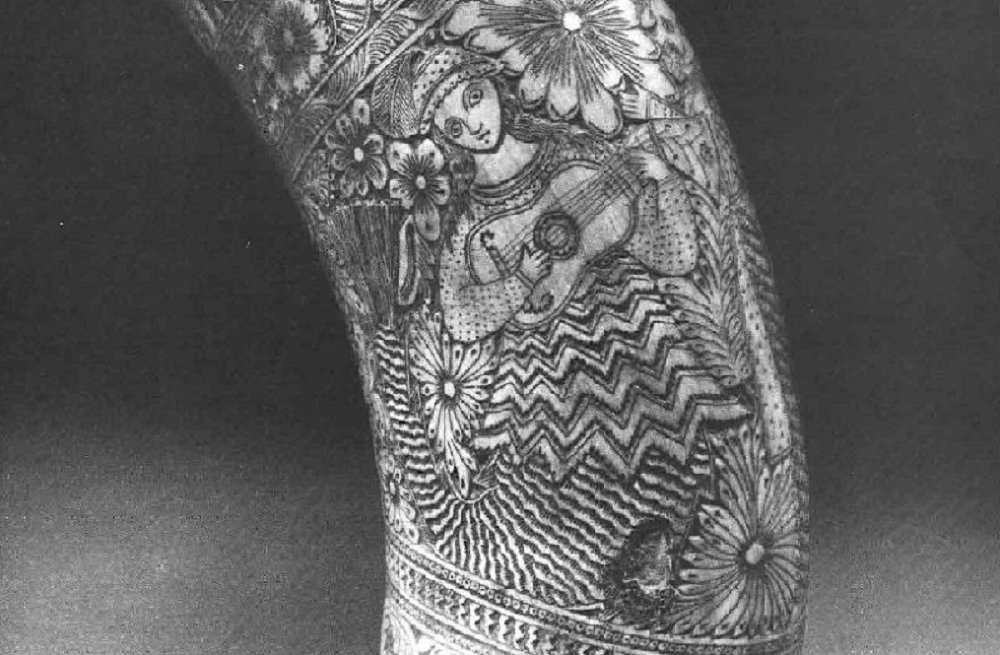
An engraved drinking horn dated 1872 and attributed to the lower Mantaro Valley of central Peru bears the image of a siren playing a plucked-string instrument. The figure occupies part of a densely ornamented surface, surrounded by flowers, geometric patterns, and other decorative elements.
The object was reproduced by Francisco Stastny in Las artes populares del Perú (1981, fig. 157), within his discussion of nineteenth-century Peruvian horn vessels. Its significance extends beyond the representation of a musical instrument. It documents the persistence and transformation of a visual motif that had circulated widely through the colonial Andes and remained present in republican-period popular art.
The instrument held by the siren resembles a small guitar-family chordophone, with a waisted body, neck, and soundhole. The engraving does not provide sufficient detail to establish its precise identification, particularly its stringing and tuning arrangement. It is therefore preferable to describe it as a guitar-like instrument rather than identify it conclusively as a guitar or charango.
The engraved horn
The vessel belongs to a group of elaborately decorated drinking horns produced in nineteenth-century Peru.
Stastny describes examples manufactured from bovine horn and ornamented with human figures, animals, flowers, sirens, and interlacing designs. Some include inscriptions identifying their owners. Their decoration was produced through incision, hatching, and the application of dark pigment to emphasize the engraved figures.
According to Stastny, several surviving examples exhibited sufficiently similar stylistic characteristics to suggest the work of a single artisan active around 1872. This attribution identifies a possible workshop relationship but does not establish the identity of the maker.
The technique is especially important. Stastny relates these horn vessels to the engraved-gourd traditions of Ayacucho, in which artisans employed incised outlines, hatched backgrounds, and darkened surfaces to produce intricate figural compositions.
The horn therefore belongs to a history of decorated containers. Its musical significance resides in the image engraved upon it.
Sirens in Andean visual culture
The siren entered colonial Andean imagery through European religious, literary, and artistic traditions. Its representations circulated in printed images, church decoration, textiles, metalwork, and drinking vessels.
In European iconography, the siren possessed several overlapping meanings. Associated with enchanting song, dangerous attraction, and moral temptation, the figure appeared in different forms, including the bird-bodied creature of classical traditions and the fish-tailed woman increasingly familiar in medieval and early modern art.
The adoption of this imagery in the Andes did not produce a uniform symbolic system. Sirens appeared in colonial architecture and decorative objects, sometimes holding musical instruments such as lutes, vihuelas, or guitars. Their presence could retain European associations while acquiring meanings conditioned by local artistic practices and beliefs (Gisbert, 1980; Millones & Tomoeda, 2004).
This musical dimension deserves particular attention. The siren was not merely a mythological creature placed beside an instrument. In several Andean traditions, the relationship between sirens and music became a significant component of the figure's identity.
Musical instruments and supernatural beings
Research by Luis Millones and Hiroyasu Tomoeda (2004) provides especially useful comparative evidence for the relationship between sirens and musical instruments in southern Peru.
Working with painters from Sarhua, Ayacucho, the authors examined representations of sirens associated with rivers, lagoons, and waterfalls. One painting depicts five sirens playing different instruments: harp, guitar, vihuela, violin, and flute.
Interviews with the artists documented oral traditions in which musicians leave their instruments near bodies of water inhabited by supernatural beings. During the night, sirens are believed to tune the instruments, improve their sound, or contribute to the acquisition of musical skill.
These traditions give the figure of the siren a role extending beyond the representation of musical entertainment. The supernatural being becomes associated with the quality of an instrument's sound and the abilities of its performer.
The chronological and geographical distance between these accounts and the 1872 Mantaro horn must be respected. The Sarhua accounts were published in 2004 and concern a different locality; they cannot demonstrate that the same beliefs informed the nineteenth-century engraving.
They do, however, establish that the association between sirens and string instruments has acquired specific musical meanings in Andean traditions. This provides a more productive context for examining the horn than a purely decorative interpretation.
Which instrument is represented?
The identification of string instruments in Andean historical imagery presents recurring difficulties.
European guitars, vihuelas, and smaller regional chordophones share several morphological characteristics. Their representation in paintings, reliefs, and engravings may omit details necessary for precise organological identification.
Julio Mendívil (2002) has examined the relationship between historical evidence and narratives concerning the origins of the charango. He notes that representations of sirens holding possible charangos in colonial churches have been used in attempts to establish an early chronology for the instrument.
Such evidence requires caution. Identifying a depicted chordophone as a charango may depend on assumptions about body size, neck proportions, or the cultural context of the image, none of which necessarily provides conclusive identification.
The Mantaro engraving presents the same problem. Its musical figure is identifiable as a plucked necked chordophone, but the surviving image does not establish its tuning, number of strings, or precise construction.
The object therefore documents the representation of a recognizable string-instrument type without offering sufficient evidence for a specific organological attribution.
This limitation does not diminish its value. Historical images contribute to the reconstruction of musical culture precisely when their possibilities and uncertainties are distinguished.
Popular art after independence
The horn also provides evidence for the continuation of artistic practices across the transition from the colonial period to republican Peru.
Its date places it approximately half a century after Peruvian independence. Yet its ornamentation belongs to a visual repertoire whose elements had circulated through the Andes during the colonial era.
Stastny's research demonstrates that nineteenth-century popular art preserved and transformed motifs associated with earlier artistic traditions. Animals, fantastic beings, floral designs, and human figures continued to appear on utilitarian and decorative objects manufactured for different social groups.
The engraved horn illustrates this persistence. Its siren belongs to an inherited iconographic repertoire, while its execution reflects the techniques and conventions of regional craftsmanship. It would be misleading, however, to describe the figure simply as a colonial remnant. The survival of an image does not necessarily entail the unchanged survival of its earlier meaning.
Readings
- Gisbert, Teresa. 1980. Iconografía y mitos indígenas en el arte. La Paz: Editorial Gisbert y Cía.
- Mendívil, Julio. 2002. "La construcción de la historia: el charango en la memoria colectiva mestiza ayacuchana." Revista Musical Chilena 56 (198): 63–78.
- Millones, Luis, and Hiroyasu Tomoeda. 2004. "Las sirenas de Sarhua." Letras 75 (107–108): 15–31.
- Podgorny, Irina. 2022. "Hecho en Perú." Hilario. Artes Letras Oficios, no. 15, May.
- Stastny, Francisco. 1981. Las artes populares del Perú. Lima: EDUBANCO, Fundación del Banco Continental para el Fomento de la Educación y la Cultura.