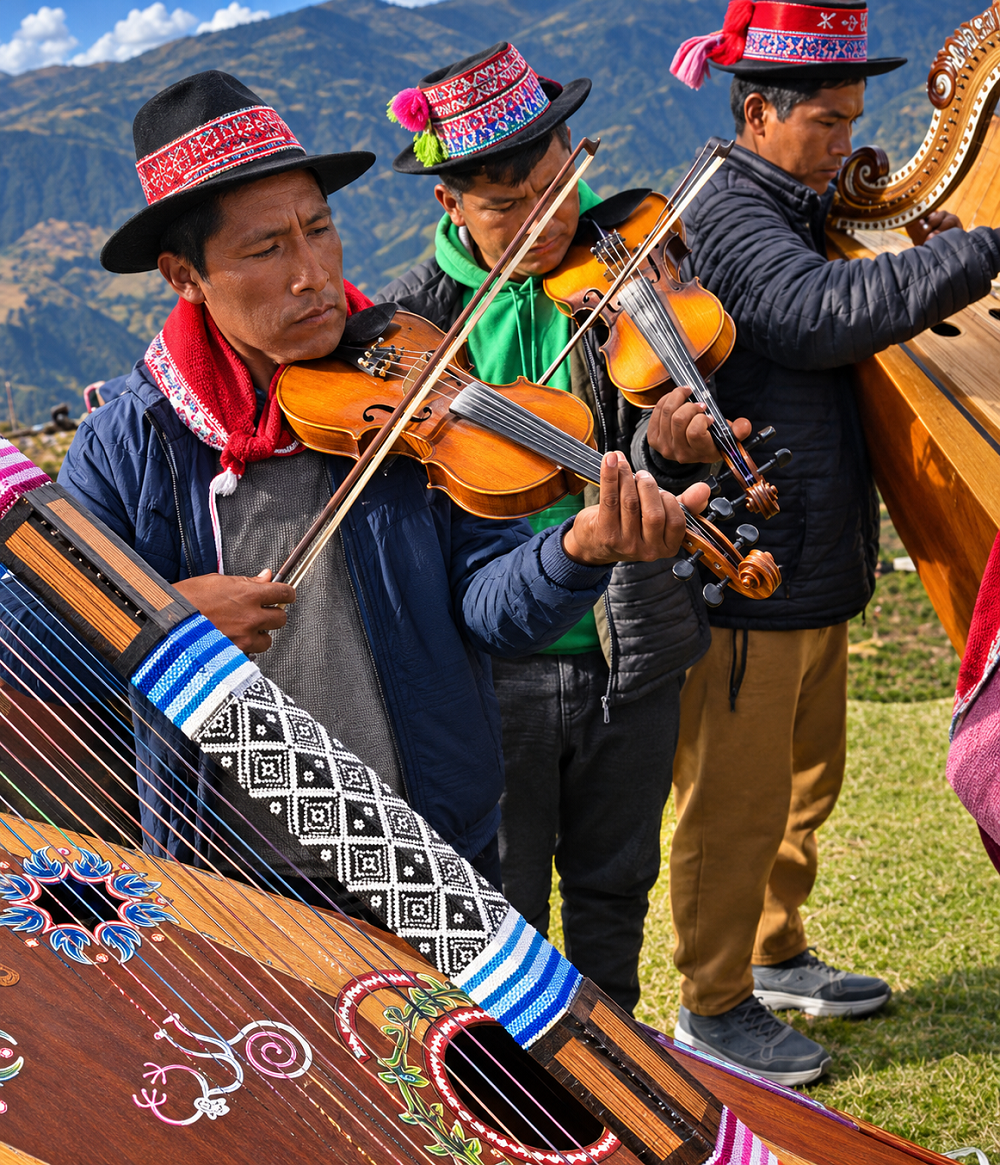
Huayno in Ayacucho
Note 028
Home > Blog A Musician's Log > Note 028
Music in its social setting
In August 1997, researchers recording the Fiesta del Agua in Alcamenca, Ayacucho, documented a huayno performed with harp and violin. The musicians accompanied the arrival of participants in a communal water-management ritual, while the harp's resonating box was struck by hand to provide additional percussion. The recording was subsequently published in Traditional Music of Peru, Vol. 6: The Ayacucho Region, an ethnographic collection assembled through fieldwork conducted between 1995 and 1998 (Ulfe, 2001).
The recording documents a musical configuration that differs from the instrumental arrangements commonly associated with urban Ayacucho. Its significance lies not in any supposed absence of technological mediation, but in the relationship between instruments and the circumstances of performance. Harp, violin, and percussion accompany a collective activity whose organization extends beyond the music itself.
Yet this configuration cannot stand for all Ayacucho huayno (or wayno). The region contains different instrumental traditions, performance conventions, and musical repertoires, shaped by distinctions between provinces, communities, and social environments.
The ensemble is therefore better understood as a variable configuration than as a fixed collection of instruments.
Regional configurations
In his study of Ayacucho wayno, Carlos Huamán López (2006) describes differences in instrumental preference across the region. Drawing on the work of Rolando Carrasco Segovia, he identifies quena notched flute, harp, and violin in Lucanas and Puquio; guitar and charango in Parinacochas and Paucar del Sara Sara; and guitar and accordion in parts of Lucanas and Andamarca. He also documents harp-and-violin configurations in rural repertoires from Huamanga, Huanta, Cangallo, Víctor Fajardo, and La Mar.
These distinctions are not absolute. Instruments circulate between localities, and individual performers work across several traditions. Nevertheless, they demonstrate that the designation huayno ayacuchano encompasses a variety of instrumental formations.
The contrast between rural and urban practice is particularly significant. In Huamanga, the guitar, mandolin, charango, and other string instruments acquired prominent positions within urban musical culture. The estudiantina, an ensemble model associated with organized public performance, developed a repertory of huaynos, yaravíes, and other regional forms.
These configurations also intersect with historical distinctions between Indigenous and mestizo musical practices. Such categories should not be treated as fixed musical identities, but they have influenced the social recognition of particular instruments, repertories, and performance techniques.
The regional sound of huayno emerges from these overlapping musical histories rather than from a universally established ensemble.
The harp: tuning, bass, and articulation
The Ayacucho harp offers particularly clear evidence of regional instrumental differentiation.
In his detailed investigation of the Huamanga harp tradition, Claude Ferrier (2016) identifies characteristics involving string materials, tuning systems, register, ornamentation, and accompaniment techniques. He distinguishes the predominantly nylon-strung harp associated with Huamanga from configurations in southern Ayacucho, where metal strings may occupy the upper part of the instrument.
Stringing practices are therefore not merely interchangeable construction choices. They contribute to distinctions in timbre and technique that musicians associate with particular regional styles.
Ferrier also documents a characteristic approach to tuning in the Huamanga tradition. In certain minor-key repertoires, performers raise the seventh degree within a specific octave of the instrument, allowing harmonic relationships that would otherwise be unavailable on a conventionally tuned diatonic harp.
The harpist Otoniel Ccayanchira provides a particularly instructive example. His instrument, documented by Ferrier, possesses thirty-seven strings extending into an unusually low register. The configuration permits bass notes required by harmonic progressions characteristic of his style. It would be inaccurate, however, to generalize this particular instrument's dimensions and compass to every Ayacucho harp.
Equally important is the technique of the left hand. In Huamanga performance, bass strings may be articulated with the palm facing outward, producing a dry, strongly defined attack. These bass figures, known as bordones, can introduce syncopation and rhythmic variation beneath the melodic line.
The harp therefore does more than supply harmonic support. Its bass register participates in the rhythmic organization of the music, while the upper register contributes melodic material and extensive ornamentation.
These characteristics are demonstrable through instrumental analysis. They do not require attributing the harp's construction or technique to an unverified need to overcome wind, altitude, or outdoor acoustic dispersion.
Violin, melody, and ensemble relationships
The violin occupies an important place in several rural Ayacucho traditions, particularly in association with the harp. Yet its relationship to the ensemble changes with the repertoire and ceremonial setting.
The huayno recorded in Alcamenca in 1997 documents one such pairing. Other recordings in the same collection demonstrate the presence of harp and violin in wedding celebrations and in related ceremonial genres. These performances establish the importance of the instrumental combination without implying that the instruments always perform identical functions.
Ayacucho violin traditions also exhibit regional differences in technique and musical organization. Research on the violin of Lucanas and the danza de tijeras, for example, documents ornamentation, locally transmitted playing techniques, and the violinist's important role in directing musical performance (Arce Sotelo, 2006). These findings concern a related but distinct repertoire and cannot simply be transferred to all rural huayno.
What can be established is the flexibility of the violin's position within Ayacucho's musical landscape. It may participate in a small instrumental pairing, accompany singers, or form part of a larger ensemble incorporating plucked strings and aerophones.
The musical relationships among these instruments cannot be determined from their classification alone. They depend on the repertoire, the performance tradition, and the conventions maintained by the musicians.
Voice, poetry, and dance
The instrumental analysis of huayno is incomplete without its vocal and poetic dimensions.
Ayacucho huayno is performed in Quechua and Spanish, and its texts address subjects including love, separation, migration, social conflict, and attachment to particular places. Huamán López (2006) emphasizes the relationship among poetry, music, and dance, treating their interaction as fundamental to the genre's historical development.
The voice may be accompanied by a harp-and-violin ensemble, by guitars and charangos, or by the more elaborate instrumentation associated with urban groups. Vocal practices likewise vary among regional and social traditions. The distinction between rural and urban singing cannot be reduced to a universal opposition between nasal projection and cultivated vocal tone.
The musical form also permits considerable variation. Repeated melodic sections and the concluding fuga, often associated with increased rhythmic intensity, provide opportunities for instrumental elaboration and collective participation. In the Huamanga harp tradition, ornamental passages and characteristic scalar figures may separate repetitions or articulate transitions between sections (Ferrier, 2016).
The relationship between voice and instrumentation consequently involves more than balancing melodic lines against accompaniment. The arrangement of sections, the repetition of texts, and the instrumental transitions contribute to the organization of performance.
Percussion beyond the instrumental inventory
The Alcamenca recording offers a particularly useful example of the limits of conventional instrument descriptions.
The accompanying documentation specifies that the harp's resonating box was used as a cajón, struck with the hands in the manner of a drum. The resulting percussion accompanied the harp and violin during a communal ceremony (Ulfe, 2001).
This detail does not establish a distinct percussion tradition derived from the Afro-Peruvian cajón, nor does it demonstrate the habitual use of benches, crates, or other improvised objects in Ayacucho huayno. It documents something more specific: the temporary employment of an existing instrument's body as an additional sound-producing surface.
From an organological standpoint, the example is significant. The harp remains a chordophone when its strings are plucked, but its resonating body can simultaneously function as a struck percussion surface.
The instrument's classification describes its principal sound-producing mechanism. It does not exhaust the possibilities of its use in performance.
Such practices suggest that ensemble morphology should be investigated through observed musical activity as well as through inventories of instruments.
Recording and musical transformation
The distinction between music performed within local celebrations and music produced for commercial circulation has shaped Ayacucho's musical history. Nevertheless, recording should not be understood simply as the removal of an originally authentic sound from its natural environment.
Commercial and institutional recordings have documented a variety of ensemble configurations. A recording by the Estudiantina Típica Ayacucho, released in 1958 and preserved in the Smithsonian Folkways catalogue, credits harp, two guitars, bandola, quena, and violin. Its instrumentation already differs substantially from the harp-and-violin pairing recorded in Alcamenca decades later.
Such differences cannot be explained solely by the recording environment. They also reflect contrasting musical traditions, ensemble conventions, and arrangements.
Research on urban Ayacucho huayno has further demonstrated the importance of examining melody, harmony, rhythm, and timbre as historically changing musical characteristics rather than assuming that the genre possesses a single stable acoustic profile (Ramírez Pérez, 2020).
Recorded performances are consequently valuable documents, but they require contextual interpretation. A microphone captures a particular configuration at a particular moment. The resulting sound depends on the musicians, the instruments, the repertoire, the location, and the recording process.
A field recording does not automatically provide a more authentic account than a commercial recording. Each preserves evidence of a different musical situation.
Morphology as a relationship
The musical traditions of Ayacucho demonstrate the limitations of defining an ensemble solely through the instruments it contains.
The same harp may serve as a melodic and harmonic instrument, provide rhythmically elaborate bass accompaniment, or contribute percussion through its resonating body. The violin participates in different instrumental relationships depending on local practice. Voice, dance, and ceremonial activity further transform the organization of musical performance.
These differences are not deviations from an otherwise uniform regional sound. They are part of the historical constitution of Ayacucho's musical diversity.
Understanding huayno outside the studio therefore requires more than identifying the sound of unamplified instruments. It requires examining the interactions among material construction, instrumental technique, repertoire, performance context, and social organization.
The ensemble is not simply an arrangement of musical objects. It is a set of relationships established and continually reproduced through performance.
Readings
- Arce Sotelo, Manuel. 2006. La danza de tijeras y el violín de Lucanas. Lima: Instituto de Etnomusicología, Pontificia Universidad Católica del Perú / Instituto Francés de Estudios Andinos.
- Ferrier, Claude. 2016. "El arpa en Huamanga: ¿tradición y estilo musical acordes a los retos del siglo XXI?" TRANS: Revista Transcultural de Música 20.
- Huamán López, Carlos. 2006. "El wayno ayacuchano como tradición oral, poética, musical y dancística." Latinoamérica. Revista de Estudios Latinoamericanos 42: 79–106.
- Ramírez Pérez, Raúl Ladislao. 2020. Las características musicales del huayno tradicional ayacuchano urbano. Thesis in Music, Pontificia Universidad Católica del Perú.
- Folkways Records. 1958. "Huayno (Peru)." Performed by Estudiantina Típica Ayacucho. In Dances of the World's Peoples, Vol. 3: Caribbean and South America, track 10. FW06503.
- Smithsonian Folkways Recordings. 2001. Traditional Music of Peru, Vol. 6: The Ayacucho Region. SFW40449.
Video. From YouTube user Cepa Studios.