Cueca
Note 027
Home > Blog A Musician's Log > Note 027
One dance, multiple traditions
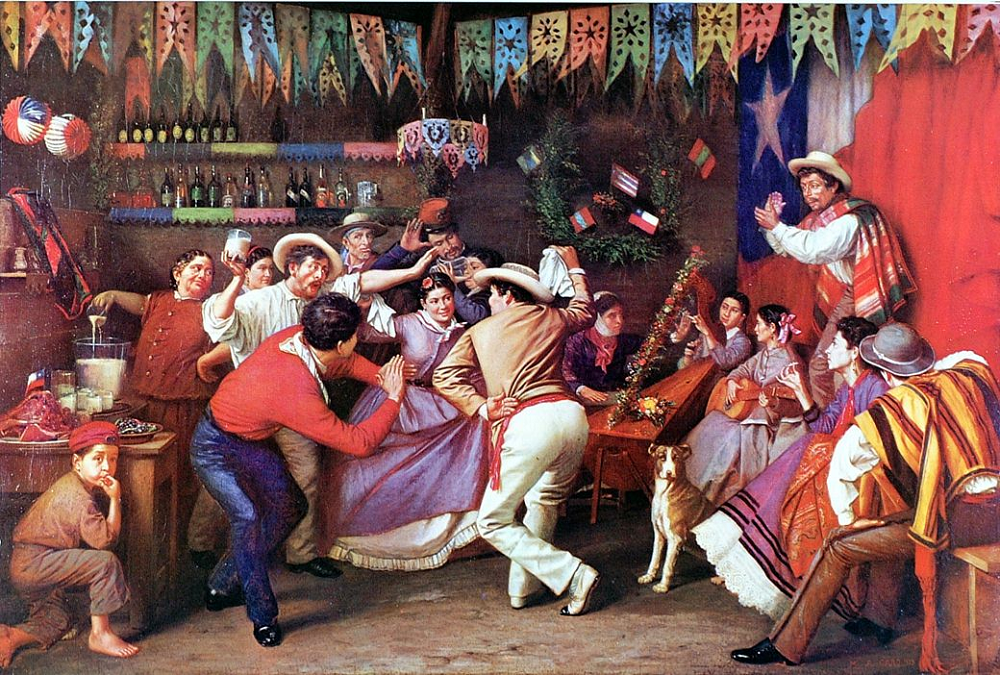
In September 1979, the Chilean military government officially declared cueca the national dance. The decree presented it as an expression of national unity, capable of representing Chilean identity despite the country's cultural diversity. Yet the musical practice brought under this designation was already heterogeneous, encompassing different regional repertoires, instrumental ensembles, vocal techniques, and social settings.
The national recognition did not create this diversity, nor did it eliminate it. Rather, it formalized a relationship between a particular musical and choreographic tradition and the representation of the nation. This relationship had developed over decades through folkloric scholarship, educational institutions, commercial recordings, and public performances (Spencer, 2021).
The resulting category conceals an important distinction. Cueca identifies a recognizable musical and choreographic form, but it also encompasses historically situated practices that cannot be reduced to a single performance model.
A shared musical structure
Despite its regional diversity, cueca exhibits recurring musical and poetic characteristics. The traditional sung form commonly follows a fourteen-line structure comprising a cuarteta, two seguidillas, and a concluding remate. Its rhythmic organization combines groupings associated with 6/8 and 3/4, producing the alternation of accents generally described as hemiola.
These characteristics provide a recognizable framework, but they do not prescribe a uniform interpretation. Melodic phrasing, accompaniment patterns, tempo, vocal articulation, and the relationship between musicians and dancers vary according to regional and social traditions. Even the conventional poetic structure admits exceptions and adaptations.
The distinction is particularly important because musical notation captures only part of the practice. The rhythmic organization of cueca also depends on the articulation of instrumental accompaniment, the accentuation of sung phrases, and the movements of the dancers. Variations in performance may therefore be substantial even when the underlying musical form remains recognizable (Loyola & Cádiz, 2010).
The existence of a shared structure does not imply the existence of a single sound.
Instruments and regional practices
Instrumental diversity is among the most immediately observable characteristics of Chilean cueca.
In rural areas of central Chile, the guitar has traditionally occupied an important position, accompanying female singers and frequently providing both harmonic support and rhythmic articulation. In some performances, the instrument is also struck or tañido to reinforce the rhythm, while clapping contributes an additional percussive layer.
Elsewhere, the instrumental configuration changes considerably. Northern cuecas may be performed without singing, using brass bands or ensembles incorporating Andean aerophones and percussion. In Chiloé, accordion, guitar, and bass drum accompany vocal traditions whose performance conventions differ from those of central Chile.
Urban cueca introduces further combinations. The styles commonly described as chilenera, brava, or chora, associated particularly with the popular districts of Santiago and Valparaíso, have employed guitars, accordion, piano, and pandero. The harp also belongs to the wider instrumental history of cueca and cannot be assigned exclusively to rural performance (Biblioteca Nacional de Chile, n.d.).
These differences complicate any attempt to identify a definitive instrumental ensemble. The guitar may provide the rhythmic foundation in one setting, while another configuration relies on piano, accordion, or wind instruments. Percussion may be produced by dedicated instruments, by the guitar itself, or by participating dancers and spectators.
Instrumental morphology alone cannot explain these distinctions. What matters is how particular sound-producing resources become organized within local performance traditions.
Voices and performance communities
The distinction between rural and urban cueca also involves vocal organization and the social relationships among performers.
In the urban tradition known as canto a la rueda, singers traditionally organized themselves in a semicircle or line, entering successively to maintain the continuity of the musical performance. This practice developed within predominantly male singing environments associated with urban occupations, markets, and popular gathering places.
Its vocal aesthetics emphasize projection, collective coordination, and the ability to sustain a continuous exchange among singers. The spatial organization of the performers is therefore part of the musical system: each voice enters within an established sequence rather than functioning simply as an independent soloist.
This organization differs from many rural singing traditions and from staged folkloric ensembles, where vocal parts may be distributed according to other performance conventions.
Nevertheless, the history of urban cueca is not exclusively masculine. Christian Spencer's research documents the emergence of female urban cueca ensembles during the early twenty-first century, including groups that adopted and reinterpreted canto a la rueda. Their participation challenged established assumptions about the relationship between vocal technique, gender, and musical authority (Spencer, 2011).
The transformation of the tradition thus occurred not only through changing instrumentation or repertoire, but also through changes in who could participate and under what conditions.
The construction of a national sound
The identification of cueca with Chilean nationality developed well before its official recognition in 1979.
During the first half of the twentieth century, commercial recording and radio broadcasting contributed to the consolidation of música típica chilena, a popular musical category strongly associated with the rural imagery of central Chile. Ensembles such as Los Cuatro Huasos, Los Huasos Quincheros, and Los Provincianos helped establish a recognizable repertory of cuecas and tonadas for urban audiences.
This repertoire was not simply rural music transferred intact into recording studios. It involved arrangements, vocal harmonization, professional ensemble organization, and stage presentation. The resulting performances drew upon rural musical references while adapting them to commercial entertainment.
The recording industry was particularly active in this process during the 1940s and 1950s. In 1942, the Victor label released Cantares de Chile, a collection of twelve selections of Chilean music distributed across six records. Radio programmes dedicated to national repertories expanded during the same period, while educational and cultural institutions promoted the collection, classification, and public presentation of folkloric material (Costa Garcia, 2009).
These developments made particular representations of rural Chile increasingly visible and audible. The figure of the huaso, accompanied by characteristic clothing, musical repertory, and performance conventions, acquired a prominent position in the public representation of national tradition.
Yet this image did not encompass the entirety of cueca practice. Urban working-class traditions, northern instrumental forms, and other regional variants continued to exist outside, or alongside, the models most prominently circulated through commercial media.
Nationalization and its contradictions
The official declaration of cueca as Chile's national dance, signed on September 18, 1979, and published on November 6, was not merely symbolic. Decree No. 23 instructed state institutions to promote its teaching, dissemination, and study. It also established an annual national cueca competition for primary and secondary school students.
Under the military dictatorship, the designation participated in a broader effort to define and promote selected representations of Chilean national culture. A particular image of cultural unity was placed at the centre of public policy.
However, cueca simultaneously occupied other political and social spaces. Urban cueca brava maintained associations with popular neighbourhoods and musical environments that differed from official folkloric representation. The cueca sola, performed by women demanding information about relatives detained and disappeared under the dictatorship, transformed the customary paired dance into an expression of absence and political denunciation (Rojas Sotoconil, 2009).
The same musical and choreographic tradition could therefore serve competing representations of national identity.
The formal declaration of a national dance did not establish control over every form of its performance or interpretation.
Canon and continuity
The construction of cueca as a national tradition involved more than the selection of a repertoire. It also shaped the categories through which musical practices were described, taught, recorded, and evaluated.
Folkloric research and institutional teaching helped establish formal descriptions of the dance. Commercial performers made particular arrangements familiar to large audiences. State recognition reinforced the association between cueca and national identity. Each process contributed to the circulation of certain models without necessarily eliminating alternatives.
Christian Spencer (2021) has described how the scholarly literature itself participated in this construction. Debates about origins, ethnicity, authenticity, and nationality gradually reinforced an image of cueca as a unified and historically continuous genre, even when the evidence pointed toward more complex processes of transmission and transformation.
This observation does not invalidate the usefulness of the category cueca. Its shared musical characteristics and historical connections are real. The difficulty arises when a descriptive category becomes a normative definition of how the music ought to sound, who should perform it, or which practices can claim authenticity.
The continued development of rural traditions, urban performance communities, women's ensembles, and newer interpretations demonstrates that the national canon has never exhausted the musical possibilities of cueca.
Its history is therefore not a movement from diversity toward a completed standard. It is a continuing relationship between recognizable musical forms, changing performance practices, and the institutions that attempt to represent them.
Readings
- Biblioteca Nacional de Chile. s. f. "La cueca." Memoria Chilena. https://www.memoriachilena.gob.cl/602/w3-article-3510.html
- Biblioteca Nacional de Chile. s. f. "Forma coreográfica y musical según la zona geográfica." Memoria Chilena. https://www.memoriachilena.gob.cl/602/w3-article-93130.html
- Chile, Ministerio Secretaría General de Gobierno. 1979. Decreto N.º 23: Declara a la cueca danza nacional de Chile. Promulgado el 18 de septiembre y publicado el 6 de noviembre. Biblioteca del Congreso Nacional de Chile.
- Costa Garcia, Tânia da. 2009. "Canción popular, nacionalismo, consumo y política en Chile entre los años 40 y 60." Revista Musical Chilena 63 (212): 11–28.
- Loyola, Margot, y Osvaldo Cádiz. 2010. La cueca: danza de la vida y de la muerte. Valparaíso: Ediciones Universitarias de Valparaíso.
- Rojas Sotoconil, Araucaria. 2009. "Las cuecas como representaciones estético-políticas de chilenidad en Santiago entre 1979 y 1989." Revista Musical Chilena 63 (212): 51–76.
- Spencer Espinosa, Christian. 2011. "Finas, arrogantes y dicharacheras. Representaciones de género en la performance de los grupos femeninos de cueca urbana en Santiago de Chile (2000–2010)." TRANS: Revista Transcultural de Música 15.
- Spencer Espinosa, Christian. 2021. "Principales ejes de estudio de la cueca chilena: una actualización." Neuma 14 (1): 30–55.
Video. From YouTube user Cultura Cerrillos.