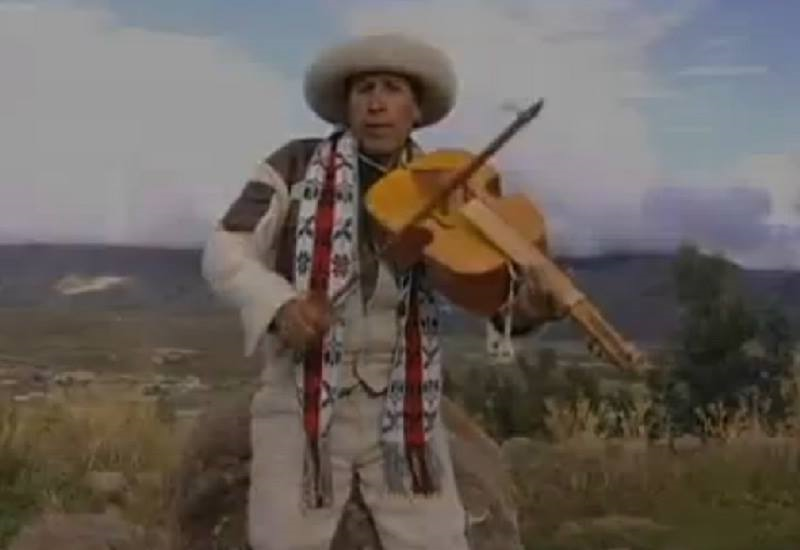
Huaylía of Chumbivilcas
Note 026
Home > Blog A Musician's Log > Note 026
Music within the Christmas cycle
In the province of Chumbivilcas, southern Peru, the huaylía (also written wayliya) forms part of a complex festive tradition in which religious devotion, collective dancing, musical performance, and ritualized fighting coexist. Its best-documented expression takes place in Santo Tomás, where the Christmas celebrations between December 24 and 26 bring together participants associated with two images of the Christ Child: the Niño de Belén and the Niño de Santo Tomás.
The celebrations are organized by carguyoq, who engage musicians and female singers to accompany processions, gatherings, and other activities. On December 25, the music also accompanies takanakuy, a form of public fighting in which participants challenge one another, sometimes to settle grievances accumulated during the year (Cama Ttito & Ttito Tica, 1999).
The relationship between music and combat is particularly revealing. Yet the huaylía is not exclusively fighting music. It accompanies religious observances, collective movement, dancing, and celebrations that extend beyond Christmas. Understanding its musical organization therefore requires examining the wider ceremonial setting rather than treating takanakuy as its sole purpose.
> Violins, harp, and voices
The instrumental configuration traditionally associated with the huaylía of Chumbivilcas consists of one or two violins carrying the melodic material and a harp providing rhythmic accompaniment. The ensemble also includes cantoras, groups of women who sing in a high vocal register and conclude their stanzas with recurring refrains, frequently variations of huaylía hia huaylía huaylía.
The melodic organization is relatively concise, relying on repeated phrases and a persistent rhythmic pattern. Singers and dancers may reinforce the rhythm with a rattle constructed from a Y-shaped wooden frame fitted with suspended metal plates. These elements produce a musical texture in which strings, voices, and percussion contribute to the continuity of collective movement (Ministerio de Cultura, 2016).
The division of musical labour is significant. The violin carries melodic figures, but it does not independently organize the performance. The harp, singers, rattles, and movements of the participants contribute to an interconnected musical practice.
The repertoire also changes according to the occasion. Lyrics may express devotion to Christian figures, address romantic relationships, or invoke courage and honour. Some songs recorded by Cama Ttito and Ttito Tica explicitly encourage confrontation, referring to challenges, adversaries, and physical danger. Others belong to devotional or festive contexts without referring directly to fighting.
Consequently, the relationship between music and takanakuy cannot be reduced to instrumental accompaniment. Singing participates in the public expression of rivalry, encouragement, and collective identity. Nevertheless, the rules and boundaries of individual fights are maintained by human participants and designated arbiters, not demonstrably by musical tempo or phrasing.
The violin transformed
The violin's presence in Chumbivilcas belongs to the longer history of European string instruments becoming incorporated into Andean musical life during and after the colonial period. Instruments introduced through colonial institutions and musical practices subsequently acquired regional repertoires, performance techniques, and social functions.
The 1978 Mapa de los instrumentos musicales de uso popular en el Perú records a distinctive violin-playing practice in Chumbivilcas. It describes the use of finger positions associated with the guitar and states that the sounds produced are predominantly armónicos, although it provides insufficient technical information to establish precisely what this term denotes in the documented practice (Instituto Nacional de Cultura, 1978, 147).
The same survey describes larger, particularly resonant violins manufactured in Huacaña, Ayacucho, but does not attribute those construction features to Chumbivilcas. Consequently, the available documentation does not establish whether the local violin underwent significant morphological modifications.
What can be established is its incorporation into a distinctive regional ensemble, with its own melodic practices, vocal conventions, festive functions, and ceremonial obligations. The historical transformation is therefore demonstrable in the instrument's musical and social use, even where changes in its physical construction remain undocumented.
Singing and fighting
The ethnographic study by Cama Ttito and Ttito Tica documents the close relationship between huaylía and the public confrontations of Santo Tomás. During the celebrations, costumed and frequently masked participants dance through the streets, visit households, gather around their respective carguyoq, and eventually assemble for the fights.
The singers accompany these activities and, during the confrontations, may direct their songs toward the participants, encouraging them to accept challenges or demonstrate courage. The music thus contributes to the social atmosphere within which rivalry becomes publicly visible.
However, the fights also depend on rules, designated spaces, and intervention by arbiters. The ethnography records both the attempts to maintain these boundaries and episodes in which confrontations escalated beyond them. The ritualization of fighting does not necessarily prevent violence from exceeding its intended limits.
The huaylía participates in this complex relationship between celebration, confrontation, and social regulation without being solely responsible for organizing or controlling it.
From live ensembles to recorded music
Changes in musical technology have altered the performance of huaylía without eliminating its presence in the festivities.
Cama Ttito and Ttito Tica already documented the use of recorded cassettes played through electronic sound systems during the 1990s. Later developments included the growing presence of guitars, mandolins, accordions, and electric basses, sometimes displacing the older violin-and-harp configuration (Ministerio de Cultura, 2016).
These changes extend beyond instrumentation. Commercial recordings, amplified performances, music videos, and celebrations organized by migrant communities have carried wayliya into settings that differ from the traditional Christmas cycle.
Recent research by Yonathan Layme Choqque (2026) describes how this expansion has generated disagreements over the appropriate representation of the tradition. Following its recognition as Peruvian National Cultural Heritage in 2016, debates emerged concerning musical authenticity, repertory, institutional regulation, and the authority to determine which forms should be preserved.
The declaration recognized wayliya as a musical and dance expression, explicitly excluding practices that violate fundamental rights. It did not constitute official recognition of the violent elements of takanakuy.
Even the official name became contested. In 2017, the Ministry of Culture changed the heritage designation from Huaylía de Chumbivilcas to Wayliya de Chumbivilcas, responding to a request from the provincial municipality.
The changing instrumental ensemble is therefore part of a broader transformation involving recording technologies, migration, commercial circulation, and cultural institutions.
An instrument within a changing practice
The history of huaylía in Chumbivilcas offers an example of how musical instruments become integrated into social practices that cannot be explained through their European origins or organological classification alone.
The violin became integrated into a regional performance tradition whose documented characteristics include distinctive playing techniques, particular ensemble configurations, and musical functions associated with collective ceremonial practices. Its association with Christmas celebrations and takanakuy demonstrates how an instrument can participate in devotional, festive, and confrontational settings simultaneously.
Yet the subsequent expansion of wayliya also shows that no particular instrument is indispensable to every manifestation of the tradition. Violin and harp remain important historical references, while recordings and newer instrumental configurations continue to reshape the musical practice.
The continuity of wayliya does not depend on the preservation of an unchanged instrumental form. It rests on relationships among repertoire, performers, ceremonial occasions, and communities, relationships that themselves remain subject to change.
Readings
- Cama Ttito, Máximo, and Alejandra Ttito Tica. 1999. "Peleas rituales: la waylía takanakuy en Santo Tomás." Anthropologica 17 (17): 151–185.
- Instituto Nacional de Cultura. 1978. Mapa de los instrumentos musicales de uso popular en el Perú: clasificación y ubicación geográfica. Lima: Oficina de Música y Danza.
- Layme Choqque, Yonathan. 2026. "Takanakuy: racionalización, violencia simbólica y disputas por la legitimidad en los congresos de la wayliya chumbivilcana (Chumbivilcas, Cusco)." Diálogo Andino, 79.
- Ministerio de Cultura del Perú. 2016. Resolución Viceministerial N.º 007-2016-VMPCIC-MC. Declaratoria de la Huaylía de Chumbivilcas como Patrimonio Cultural de la Nación. Diario Oficial El Peruano, January 20.
- Ministerio de Cultura del Perú. 2017. Resolución Viceministerial N.º 140-2017-VMPCIC-MC. Modificación de la denominación patrimonial a Wayliya de Chumbivilcas. August 4.