Hathpang and Mbiké
Note 011
Home > Blog A Musician's Log > Note 011
One-String Fiddles of the Chaco
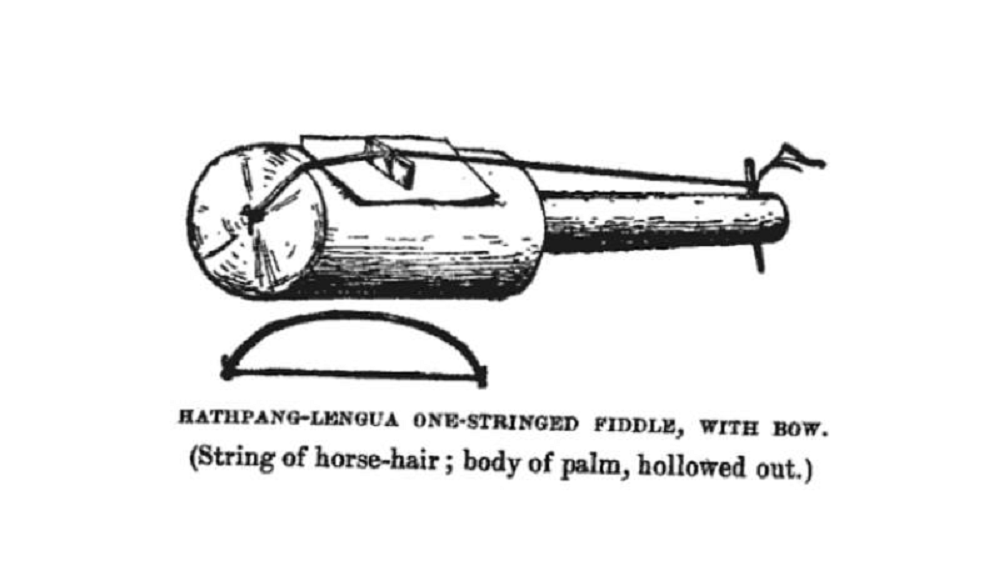
In 1911, Anglican missionary W. Barbrooke Grubb published An Unknown People in an Unknown Land, an account of the Enxet (then commonly labeled "Lengua") of the Paraguayan Chaco. Among the cultural observations included in the book is a brief description of a bowed, single-string instrument called hathpang. Grubb describes a hollowed palm-wood body covered with animal skin, fitted with a horsehair string, and sounded with a separate bow likewise strung with hair.
The description is concise. Organologically, however, it is notable.
A single string stretched over a membrane-covered resonator and activated through bow friction situates the instrument within the broad family of bowed fiddles. Structurally, it resembles the mbiké documented among Qom (Toba) communities of the Argentine Chaco during the twentieth century, particularly in the work of Carlos Vega and later Argentine ethnomusicologists.
The comparison is significant because bowed chordophones occupy a marginal place in most general surveys of Indigenous South American instrumental traditions, which tend to emphasize aerophones and percussion instruments. The existence of these Chaco fiddles complicates simplified regional distributions.
Structure and Organological Placement
From Grubb's description, the hathpang appears to have included a resonator carved from palm wood, a membrane soundboard of animal hide, a single string reportedly made of horsehair, and a separate bow also strung with hair.
Descriptions of the Qom mbiké indicate a comparable configuration: a small membrane-covered resonator, one string, and bow activation. Pitch variation is achieved through finger contact along the string rather than through fingerboard pressure, multiple strings, or fixed frets.
At the same time, the surviving mbiké tradition also demonstrates material variability. Modern documented examples include instruments constructed with industrial materials such as car oil burnt cans replacing earlier resonators. This does not erase structural continuity, but it does indicate that the instrument cannot be treated as a materially fixed form. The persistence of the sound-producing principle does not necessarily imply stability of construction, context, or meaning.
These Chaco fiddles can be situated morphologically within a wider family of one-string bowed instruments documented across Africa, parts of the Middle East, Central Asia, and European folk traditions. Structural comparison clarifies morphology.But it does not, by itself, establish historical relationships.
Documentation and Its Limits
Grubb was not a trained musicologist, and his description lacks technical detail regarding tuning, scale organization, playing technique, repertoire, or social function. Later documentation of the mbiké is somewhat more precise, yet still fragmentary when compared with the extensive documentation available, for example, for many Andean aerophones.
The evidentiary situation is uneven. The hathpang itself does not appear to survive as a documented living instrument.
Under these conditions, caution becomes methodologically necessary. The structural resemblance between the hathpang and the mbiké is clear, but continuity between them cannot be assumed. The surviving mbiké may illuminate the historical description of the hathpang organologically without providing evidence for continuity of repertoire, performance practice, symbolic meaning, or historical transmission.
The safest claim is structural similarity rather than identity.
Diffusion, Adaptation, or Local Stabilization?
Securely documented pre-Columbian bowed chordophones are absent from the Americas. Bow friction as a sound-producing principle is generally associated with post-contact historical processes, whether through European colonial presence, Afro-descendant intermediaries, or broader intercultural exchanges.
At the same time, the morphology involved is extremely simple. A one-string bowed fiddle requires relatively limited structural complexity: resonator, membrane, string, tension, and friction. Comparable instruments appear in multiple regions of the world in forms that are not necessarily historically connected in any direct way.
The Chaco instruments therefore present an interpretive problem. They are neither straightforward adaptations of European violins nor securely identifiable survivals of any single external tradition. Current evidence does not permit definitive conclusions regarding origin or transmission.
What can be stated with greater confidence is that bowed string technology became locally integrated into at least some Indigenous musical practices of the Chaco during the colonial or post-colonial period.
Beyond that, the documentation becomes too limited to support stronger historical claims.
Reconsidering the Chaco Instrumental Landscape
The hathpang and the mbiké remain unusual within the documented instrumental landscape of Indigenous Latin America. At present, they appear to be among the very few documented Indigenous one-string bowed fiddles from the region.
Their rarity does not resolve the historical questions surrounding them. If anything, it intensifies them.
One instrument survives only through sparse historical description. The other persists in fragmentary and materially transformed forms. Both occupy a poorly documented space within South American organology.
For that reason, these instruments are important not because they overturn the broader aerophone-dominant profile of Indigenous South American music, but because they expose the incompleteness of simplified instrumental maps. Even a minimal chordophone configuration, a single string activated by friction across a membrane resonator, is enough to reveal historical processes that remain only partially visible in the documentation.
The Chaco bowed fiddles do not provide a complete alternative history of Indigenous American chordophones. But they mark a small and uncertain zone within that history whose contours remain unresolved.
Readings
- Civallero, Edgardo. Instrumentos tradicionales de cuerda frotada en el Chaco. A contratiempo: Revista de música en la cultura (Biblioteca Nacional de Colombia), nº 27, septiembre 2016.
- Grubb, W. Barbrooke. An Unknown People in an Unknown Land. London: Seeley, Service & Co., 1911. Pérez Bugallo, Rubén. Catálogo ilustrado de instrumentos musicales argentinos. Buenos Aires: Ediciones del Sol, 1993.
- Vega, Carlos. Los instrumentos musicales aborígenes y criollos de la Argentina. Buenos Aires: Centurión, 1946.
Video. From YouTube user Cultura Chaco.