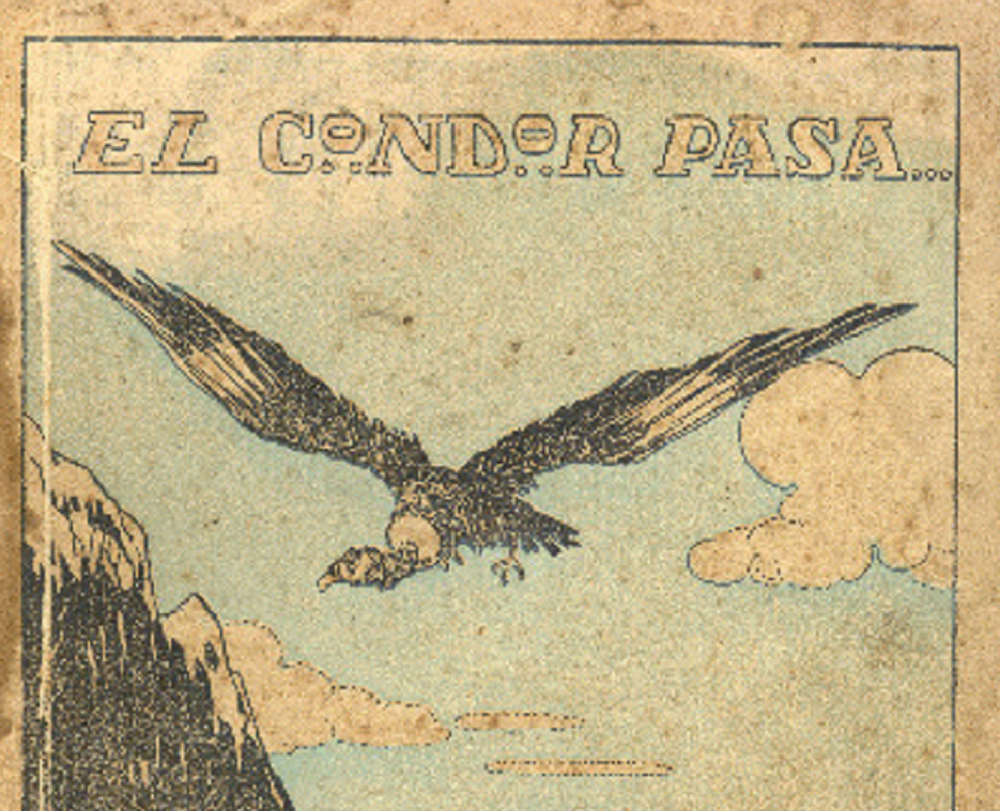
El cóndor pasa
Note 010
Home > Blog A Musician's Log > Note 010
From Zarzuela to Global Motif
In December 1913, Daniel Alomía Robles premiered a one-act zarzuela in Lima titled El cóndor pasa. It was not a song in the modern sense. It was a theatrical work: voices moving through dialogue, an orchestra shaping tension, and a staged narrative set in a mining environment in the Peruvian Andes.
Music, in that context, did not float freely. It was tied to action. It entered at specific moments, carried emotional weight because it was anchored to characters and situations, and dissolved back into the dramatic flow.
The melody with the same title that would later become famous was part of that machinery. It did not exist as an independent object. It had a role, a position, a reason to be there.
What circulates today has none of that.
Melodic Source and Early Transformation
Before anything was extracted, something had already been altered.
Alomía Robles was working within a broader early twentieth-century effort to translate Indigenous musical materials into forms that could function within national and urban artistic life. This was not a neutral act of collection. It required shaping, selecting, adapting. Extracting, too. It meant bending musical material so it could live inside a different structure.
The connection with Huk urpichatam uywakurqani, a traditional Quechua song from the Jauja region, usually translated as "I raised a little dove" and associated with intimate, melancholic yaraví or harawi-type repertoire, is often invoked as proof of origin. But it is closer to a point of friction. A melody passes through a system that bends it just enough to behave differently. What emerges is not a preserved fragment of tradition, but something already reconfigured.
By the time it enters the zarzuela, it is carrying a new logic.
Extraction and Recomposition
Then comes the decisive break.
At some point in the mid-twentieth century, the melody is lifted out of the zarzuela. Not quoted, not alluded to, but removed. Detached from the dramatic sequence that gave it direction and meaning.
Once separated, it changes. It has to. Without the structure that supported it, the melody becomes lighter, more compact, easier to repeat. Harmonic complexity is reduced, form tightens, duration shortens. What remains is not a "simplified version" of the original. It is a different kind of object.
It is a fragment built for movement.
The zarzuela stays where it is. The fragment travels.
Reorchestration and the Construction of "Andean Sound"
As the melody moves, it acquires a new body.
Arrangements begin to favor quenas, charangos, and guitars. Breath replaces orchestral density. Plucked strings replace harmonic layering. The sound becomes sparse, open, recognizable. This is the version most listeners now identify as "authentically Andean."
But this sound was not waiting inside the original work, ready to be uncovered. It was assembled later, gradually, until it became familiar enough to function as a signature. The melody settles into that frame, and over time the frame begins to feel inevitable.
What is heard as authenticity is often just repetition solidifying into expectation.
Global Circulation
By the late 1950s and 1960s, the melody had already been stabilized through the work of groups like Los Incas, whose arrangements fixed the now-familiar sound: quena in the foreground, charango and guitar supporting it, a slow unfolding that turned the melody into something both intimate and expansive. This was not just performance. It was consolidation. The fragment had found a form that could travel without losing coherence.
When Simon & Garfunkel released El Condor Pasa (If I Could) in 1970, they did not reach back to the zarzuela. They picked up this already stabilized version and carried it further. At that point, the melody no longer needed its past. It no longer required the mining narrative, the theatrical frame, or even a precise geographical context.
It carried a mood. A horizon. A vague but powerful sense of altitude, distance, and memory.
The fragment had become self-sufficient.
Archival Reconstruction and the Limits of Return
A century after the premiere, Luis Alberto Salazar Mejía reconstructed the original zarzuela from surviving manuscripts and brought it back to the stage. The orchestration reappeared. The voices returned. The structure, long obscured, became audible again.
But something had shifted.
The restored work did not feel like the "real" version reclaiming its place. It felt almost unfamiliar, as if it were the variation. The fragment had already occupied the role of origin in global listening. It had settled there too deeply.
The archive can reveal the layers. It cannot undo them.
What Actually Survived
We often imagine that music travels intact, carrying its history with it.
It doesn't.
What travels are pieces that can survive being cut loose. Pieces that can be reshaped without breaking. Pieces that fit easily into new contexts, new ears, new expectations.
El cóndor pasa did not move across the world as a theatrical work. A fragment did. And it survived precisely because it could be separated, simplified, and attached to something else.
The Sound We Think We Know
Today, when the melody is played, it feels immediate. Familiar. Almost inevitable. As if it had always existed in that form.
But what we are hearing is not a beginning. It is the end of a long sequence of transformations that have erased their own traces. The melody sounds whole because the cut that made it possible is no longer visible.
The world does not remember the zarzuela.
It remembers the fragment as if it had never been otherwise.
Readings
- Salazar Mejía, Luis (2014). El cóndor pasa... y sus misterios. Revista de Crítica Literaria Latinoamericana, 11 (80), pp. 11-37.
- Stevenson, Robert (1978). The Condor Passes: A Peruvian Zarzuela. Inter-American Music Review, 1 (1), pp. 1-30.