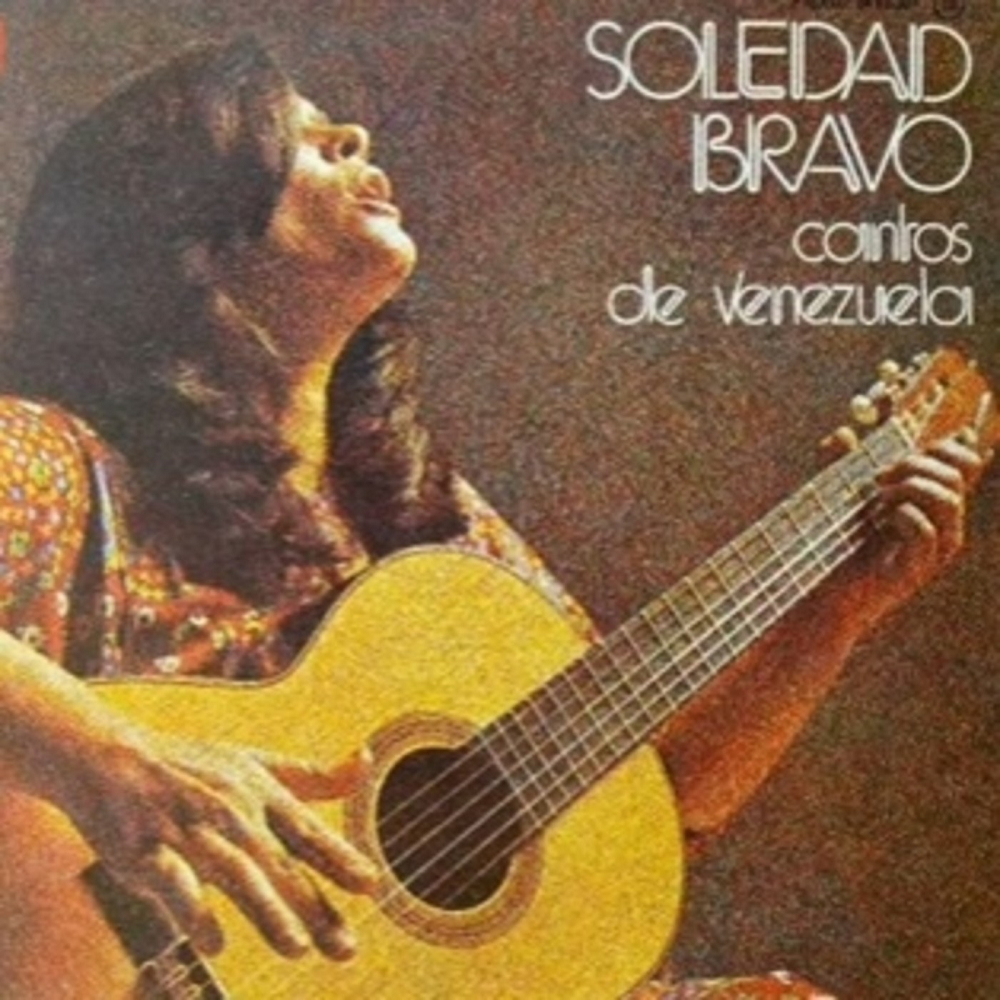
Cantos de Venezuela (1974)
Note 009
Home > Blog A Musician's Log > Note 009
A shift in position
When Soledad Bravo recorded Cantos de Venezuela in 1974, she was not entering unfamiliar territory. She had already moved through Iberian repertories, Latin American canción, and the continental networks of Nueva Canción ("New Song"). What changes in this album is not her voice, but the frame around it.
Earlier recordings often relied on a stripped format: voice and guitar, occasionally minimal accompaniment. Here, the sound expands. The album is arranged and directed by Chucho Sanoja, a figure deeply rooted in Venezuelan popular orchestral practice rather than in rural performance contexts.
That detail matters. The album is not a collection of songs. It is an arranged environment.
Repertoire without context
The track list draws from genres with strong regional anchoring: malagueña, fulía, tonada, polo margariteño, work songs. Each of these forms carries its own performance ecology. They are tied to specific contexts: eastern coastal singing traditions, Afro-Venezuelan ritual cycles, cattle work, agricultural rhythms.
In Cantos de Venezuela, those contexts do not disappear, but they are no longer operational. The songs are detached from the situations that produced them. They are reorganized into discrete tracks, each bounded by the logic of the LP format.
The listener does not encounter a cycle, a ritual, or a labor process. The listener encounters a sequence.
That shift alone transforms the music.
The arranger as constructor
Sanoja's role is not decorative. It is structural. As arranger and musical director, he determines instrumentation, texture, pacing, and transitions.
Available credits and listening evidence show a mixed ensemble logic. Traditional instruments such as cuatro and hand percussion coexist with studio elements: arranged backing vocals, controlled layering, and in some cases expanded harmonic support beyond what rural performance would require.
That is not documentation. Actually, it is selection.
Certain timbres are preserved because they signal "Venezuelan-ness." Others are introduced or stabilized because they ensure coherence across the album. The result is not any single regional sound, but a negotiated composite.
The studio becomes a filter that decides what counts as representative.
Rhythm under constraint
Traditionally, genres like fulía or work songs often operate in flexible rhythmic environments. Tempo may fluctuate. Participation can alter density. Call-and-response structures expand or contract depending on the situation.
In the studio, this flexibility narrows.
Tracks require duration. They require closure. They must begin and end cleanly. Rhythmic patterns stabilize. Irregularities are reduced, not necessarily through mechanical quantization, but through arrangement discipline. The pulse becomes more predictable, more transferable across tracks.
What was once adaptive becomes repeatable.
This does not mean the rhythm is simplified into uniformity. It means it is shaped into something that can function within an album sequence rather than within a lived event.
Voice as anchor
Bravo's voice remains the central constant. It carries expressive continuity across the album's varied material. But its role also shifts.
In a rural context, voice is often embedded within collective sound. In Cantos de Venezuela, it is foregrounded. Microphone placement, mixing, and arrangement ensure that the voice leads, while the ensemble supports.
This hierarchy is not inherent to the genres themselves. It is a studio decision.
The voice becomes the thread that stitches together otherwise heterogeneous traditions into a unified listening experience.
From practice to reference
Over time, recordings like Cantos de Venezuela acquire a second life. They stop being simply albums and become reference points.
For listeners without direct access to the original performance contexts, the recording becomes the primary encounter with these genres. Its versions of malagueña or tonada begin to define expectation. Later musicians may learn from the record rather than from community practice.
This is where the transformation becomes recursive.
The studio does not just reinterpret tradition. It feeds back into it. It stabilizes certain forms, certain tempi, certain timbral balances, which then circulate as if they were original.
The album becomes an archive that reshapes what it preserves.
Not a document, but a construction
It is tempting to read Cantos de Venezuela as a preservation project. In a limited sense, it is. It gathers repertories and gives them visibility. But preservation here operates through transformation.
The album does not capture Venezuelan folk music as it exists in situ. It constructs a version of it that can circulate, be heard repeatedly, and be recognized across contexts.
What emerges is not falsification. It is mediation. Tradition enters the studio as practice. And it leaves as format.
Readings
- Martín, Gloria. El perfume de una época: (la nueva canción en Venezuela). Editorial Alfa, 1998.
- Mendoza, Emilio. "Folk-Music Appropriation by Venezuelan Pop Music." Encyclopedia of Popular Music of the World, vol. 9. London: Continuum, 2008.
- Penín, José. "Música popular de masas, de medios, urbana o mesomúsica venezolana." Latin American Music Review 24 (1) (2003): 62-94.
- Tumas-Serna, Jane. "The 'Nueva Canción' Movement and Its Mass-Mediated Performance Context." Latin American Music Review 13 (2) (1992): 139-153.
Video. From YouTube user Stanislav Palekha.